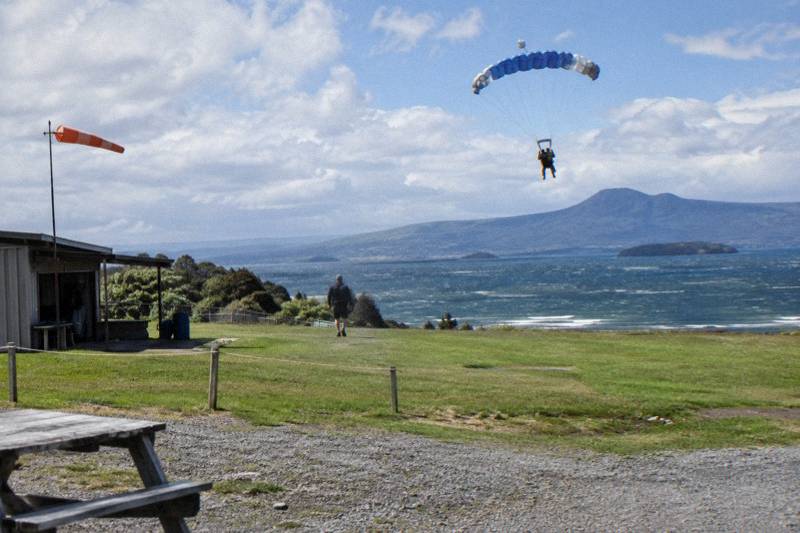
Do You Need To Be Fit To Skydive In Taupo?
The operator behind the Taupo drop zone does not ask for a fitness test. It assesses weight, body shape, mobility and health, and it asks anyone with a medical question to see a doctor first.
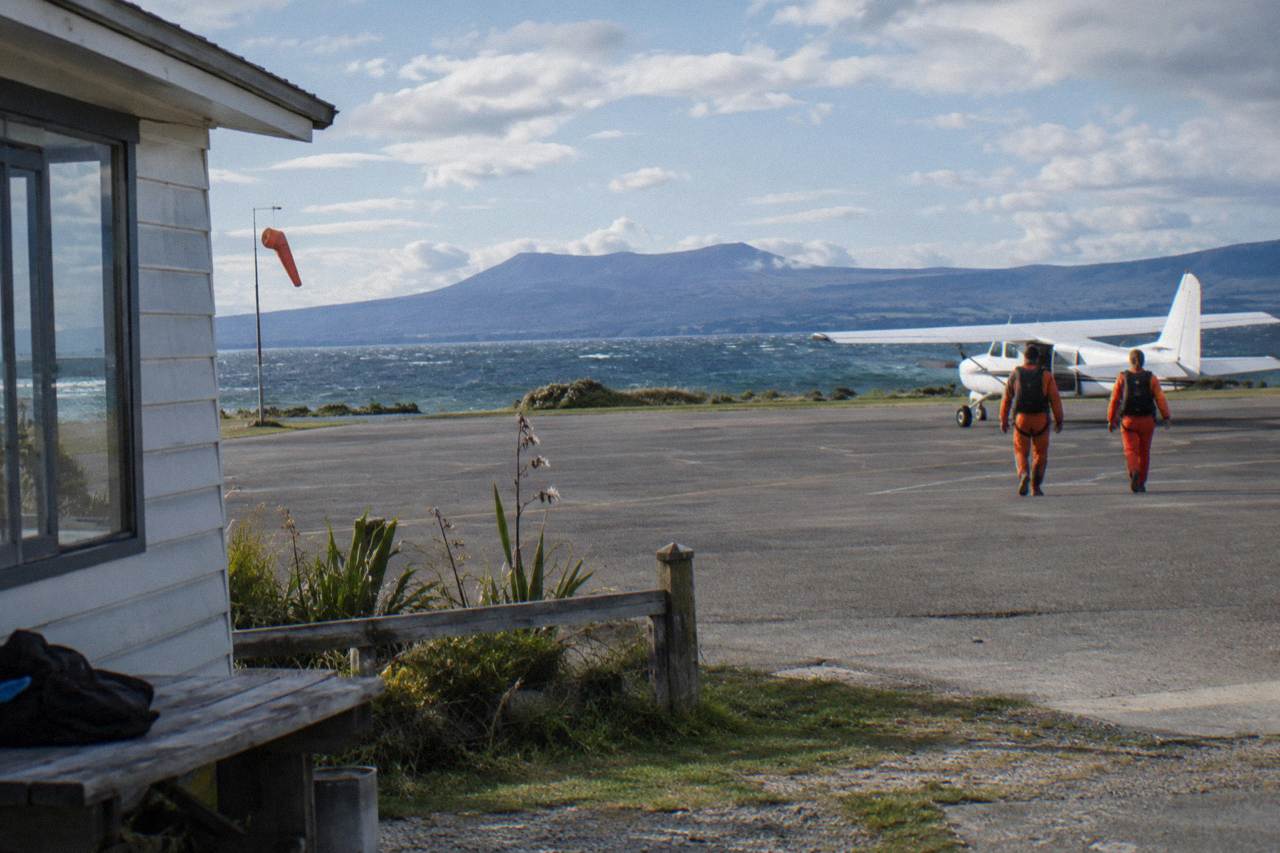
Short answer
No fitness test is stated. The operator assesses weight, body shape and mobility instead: anyone up to and over 100 kg is assessed individually by the Safety Officer. Minimum age is 8, there is no upper age limit, and anyone with a health question is told to see a doctor first.
This page sits inside the wider guide to skydiving in Taupo for first timers, which covers altitudes, prices and the day itself in full.
| Quick fact | What the operator states |
|---|---|
| Fitness test | None stated |
| Weight rule | Up to and over 100 kg assessed individually by the Safety Officer |
| Phone for weight questions | 0800 826 336 |
| Minimum age | 8, with written guardian consent under 18 |
| Upper age limit | None; the oldest jumper the operator mentions is 95 |
| Health instruction | See a doctor first; operator may decline a jump for safety |
| Fixed exclusions stated | No scuba diving within 24 hours; no drugs or alcohol |
| ID | Government photo ID required |
The question behind the question is usually anxiety, not athletics. People read "fitness requirements" and picture a treadmill test, and that picture stops them booking. The operator's own material works differently: it is built around individual assessment, a conversation with the Safety Officer, and a blanket instruction to clear medical doubts with a doctor rather than with a booking form.
Is There A Fitness Test At The Drop Zone?
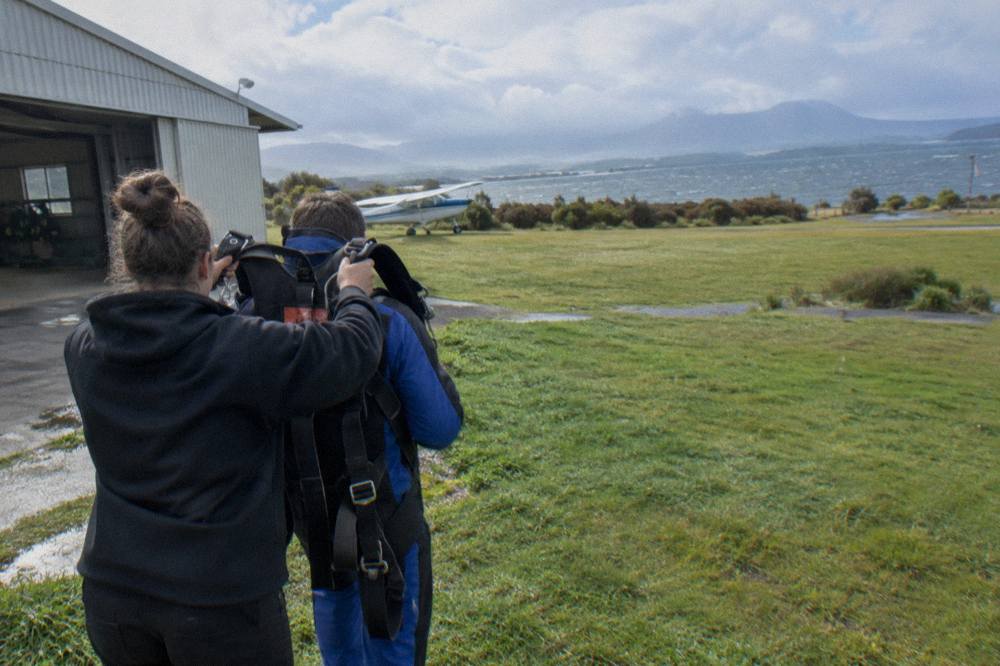
No, there is no fitness test at the drop zone. The operator's pages describe no strength benchmark or conditioning requirement, only an assessment of weight, body shape and mobility so the harness and tandem equipment fit safely, plus the instruction to see a doctor first whenever health is in question; the operator also states plainly that it may decline a jump for safety reasons.
The distinction matters because the two words sound similar and work completely differently. A fitness test is a pass or fail standard you prepare for. An assessment is a judgement made on the day by a person whose job is equipment fit and safety, applied to you specifically rather than to a category you fall into. The operator's FAQ page frames the requirement around equipment limits plus body shape and mobility, not around exercise capacity, and nowhere in its pages does it ask how far you can run or how much you can lift.
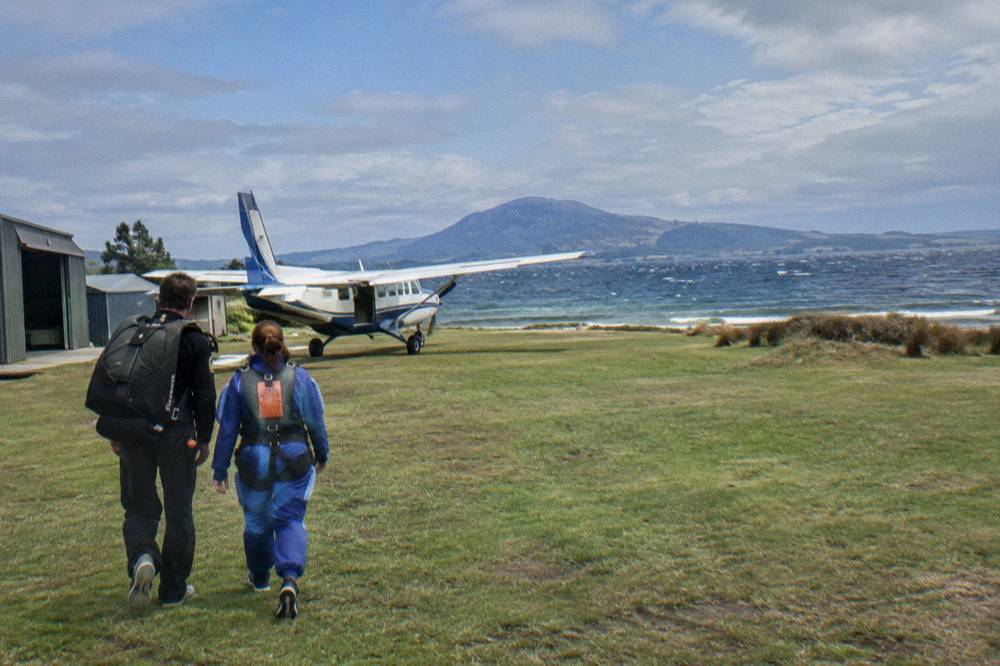
That does not mean anything goes. Tandem skydiving asks your body to do a small number of specific things: sit in a plane, be lifted and positioned at the door, hold a stable body position during freefall under the tandem master's control, and land in a posture the tandem master calls. None of that is trained for in advance. All of it is easier, and safer, when the harness fits and you can move freely enough to be positioned. Hence the emphasis on shape and mobility rather than cardio.
The honest answer for anyone unsure is a phone call rather than a guess. The operator's office number is 0800 826 336, and the pages themselves direct anyone over 100 kg to contact the office before arrival. That call is free, it happens before you pay anything on most of the options, and it converts a vague worry into a specific answer from the person who will actually make the call on the day.
If the medical side rather than the physical side is what worries you, the deeper rundown lives in the guide to medical conditions and the Taupo skydive. The short version from the operator's own pages: see a doctor first, and no condition-by-condition list exists, so never accept an invented rule from any source, including a well-meaning forum.
How Does Weight Affect Your Taupo Skydive?
Weight is the one physical factor the operator regulates explicitly. Limits come from the equipment combined with body shape and mobility, and the stated rule is that anyone up to and over 100 kg is assessed individually by the Safety Officer, with the office contactable on 0800 826 336. No fixed maximum weight and no surcharge are stated anywhere, and no per-altitude weight limit exists, so treat any hard number you see elsewhere as invention.
The mechanics are practical. A tandem harness and the canopy sized for the pair are engineered around a weight range, and body shape changes how the harness sits and whether it can be tightened correctly. That is why the operator refuses to publish a single cutoff number and instead routes heavier jumpers to an individual assessment. The Safety Officer looks at the specific person in front of them, not at a chart.
What that means for planning is simple. If you weigh under 100 kg, nothing in the operator's pages suggests a barrier. At or over 100 kg, call ahead, describe your build honestly, and expect a decision on the day. There is no stated penalty, no stated price increase, and no stated ceiling for the skydive-only tours. The only hard weight number on any page belonging to this drop zone sits on the helicopter combo's booking page, covered in its own section below.
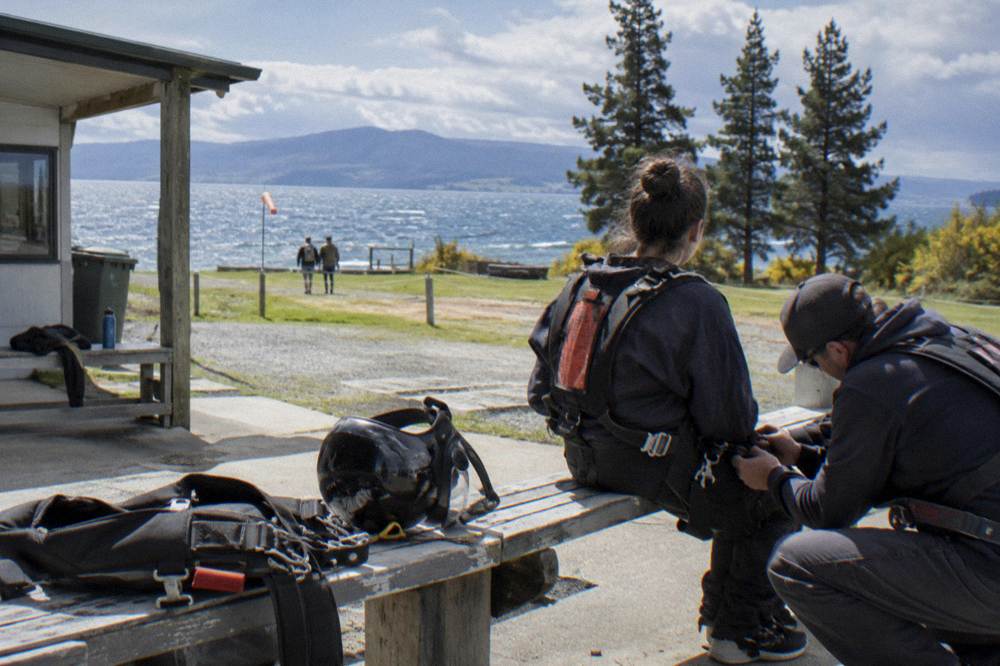
The featured 12,000ft Tandem Skydive is the natural first stop if weight is your only question: it is the one option here with a printed rating and price anchor, at 5.0 across 457 reviews and from US$194, and it carries free cancellation up to 24 hours before. The deeper planning detail, including how the assessment tends to go for heavier jumpers, is in the dedicated guide to the Taupo skydive weight limit.
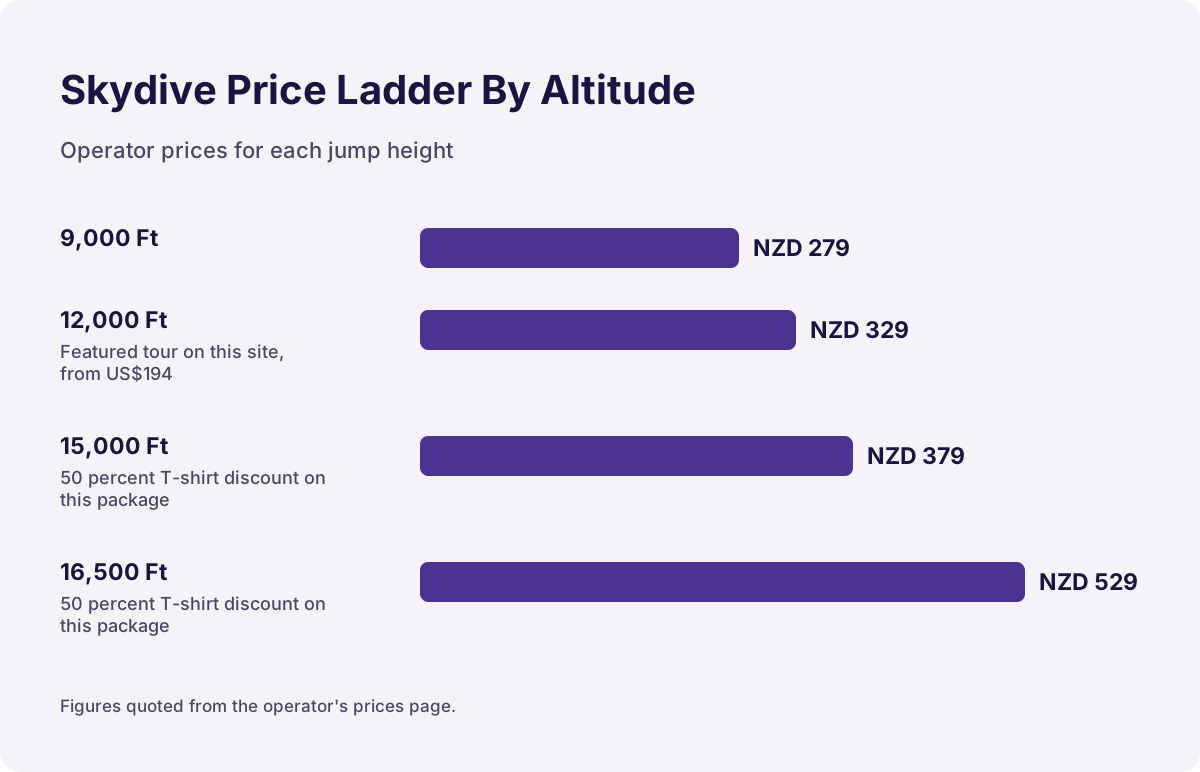
The altitude choice, for what it is worth, does not change the weight framework. The operator's price ladder runs 9,000 ft NZD 279, 12,000 ft NZD 329, 15,000 ft NZD 379 and 16,500 ft NZD 529, per the operator's prices page, and its assessment rule is one rule, applied the same way whichever height you book. Choosing a lower jump does not buy you an easier weight pass, and choosing a higher one does not add a stricter one.
What Health Conditions Matter Before You Jump?
The operator states five health-related rules: see a doctor first if you have any medical question, the operator may decline a jump for safety, no scuba diving within 24 hours, no drugs or alcohol, and bring government photo ID. Beyond those, no condition-by-condition guidance exists on its pages, no cardiac, eye, pregnancy or medication rules are stated, and any source quoting specific bans is making them up.
The scuba rule and the alcohol and drugs rule are two separate rules, not one window. Scuba diving within 24 hours before a jump is out, full stop, because of what compressed-gas diving does to the body. Drugs and alcohol are prohibited on their own terms. Merging them into a single "24 hours clean of everything" instruction, or splitting them incorrectly, both misrepresent the operator's actual terms, which are on the operator's terms page.
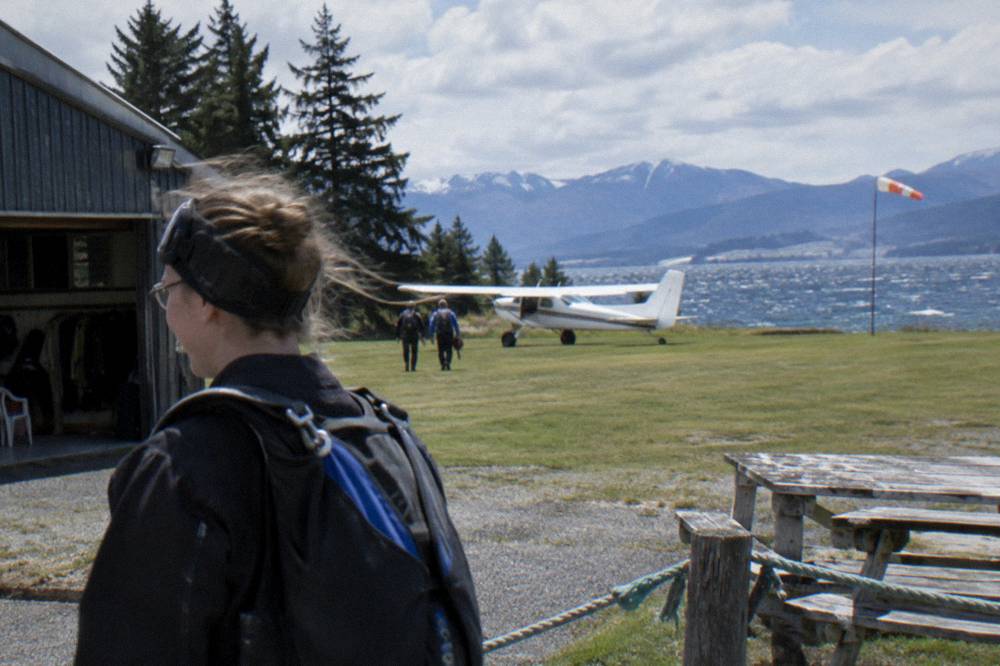
The "see a doctor first" instruction is deliberately broad, and it is the correct response to almost every medical question a booking page gets asked. Are you managing a heart condition? See a doctor first. Recently had surgery, or pregnant, or on new medication? Same answer, and the honest phrasing is that a rule for your specific case is not stated; ask the operator on 0800 826 336 after you have spoken to your own clinician. The operator then holds its own right to decline a jump for safety, which is stated openly.
| Operator health rule | What it means for you |
|---|---|
| See a doctor first | Applies whenever any medical question exists; the operator does not replace clinical advice |
| Operator may decline for safety | Final judgement sits with the drop zone on the day |
| No scuba diving within 24 hours | A standalone rule about diving, not alcohol |
| No drugs or alcohol | Separate rule, stated separately |
| Government photo ID | Required at check-in, so bring it or the jump does not run |
One practical point that trips people up: glasses are fine. The operator states that glasses fit under the supplied goggles, so poor eyesight is not a barrier and neither is wearing contacts under the standard kit. The full kit rundown, including the free neck buff and 50 percent T-shirt discount on 15,000 ft and higher packages, belongs on the prices page rather than in the fitness conversation.
A sensible order for anyone unsure: start with your own doctor, not the booking page. The operator's "see a doctor first" rule means clinical questions belong with a clinician who knows your history, and only once you have that advice should you call 0800 826 336 to hear what the drop zone itself can accommodate. Call in the other order and you will likely hear the same instruction repeated: see a doctor first. The two steps are different in kind, one medical and one operational, and skipping the first leaves the operator guessing about matters it does not diagnose. Starting with your doctor is also the fastest route to a real answer.
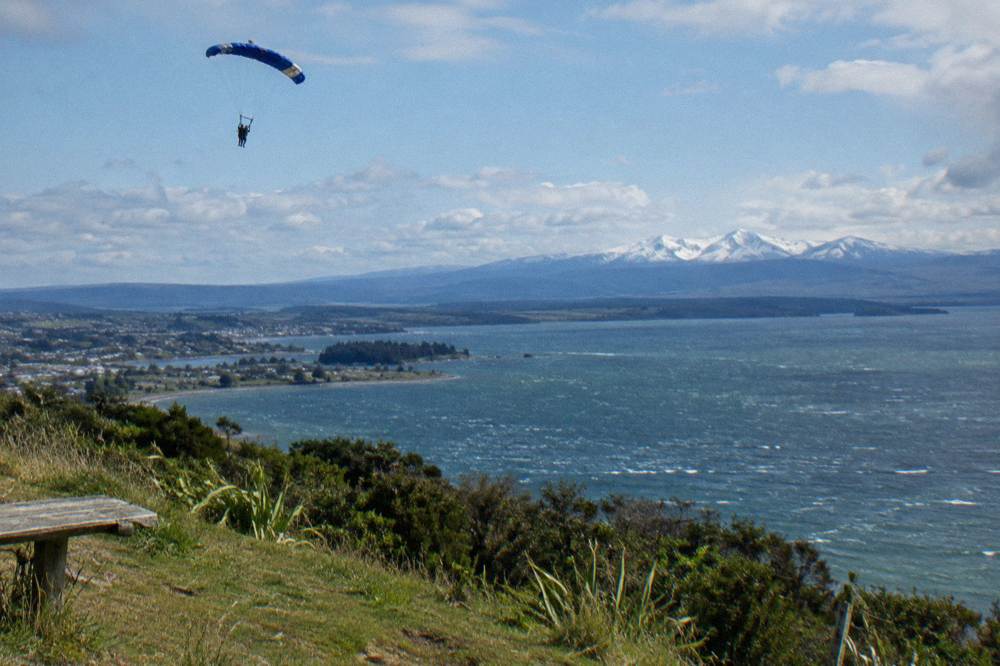
If you are pairing a dive with a jump, the arithmetic matters: book the skydive at least 24 hours after your last scuba dive, because the clock attaches to the dive itself rather than to the day as a whole. The drugs and alcohol rule carries no stated hour count of its own, so the practical reading is to arrive on the day clear-headed rather than trying to time anything.
The absence of a condition-by-condition list is itself useful information. It means answers are worked out case by case, so when you do call 0800 826 336, bring specifics: your condition, your medication, and whatever your own clinician said. The photo ID rule deserves the same respect as the medical ones, because it is a hard gate at check-in on the day, and a jump can be lost to a forgotten wallet as easily as to a hangover.
Do Age And Mobility Change The Requirements?
Yes, in specific and narrow ways. Minimum age is 8 with written parental or guardian consent for anyone under 18, and jumpers under 14 are individually assessed and must be accompanied in the plane by a known adult who pays for a skydive themselves. There is no upper age limit, the oldest jumper the operator mentions is 95, and the 16,500 ft option is restricted to ages 14 and over.
The under-14 rule deserves attention because it is stricter than most families expect. A child of 8 to 13 cannot simply be booked in alongside parents on the ground; the operator requires an adult they know to be in the plane with them, as a paying skydiver, and the child is individually assessed. Families weighing this up will find the planning detail in the guide to skydiving in Taupo with teenagers and families, including how the consent paperwork works.
At the other end of the age range, the absence of an upper limit is a deliberate statement. The operator chose to publish that its oldest mentioned jumper was 95, which signals that age alone is never the disqualifier and that its assessment stays focused on the same weight, mobility and health factors applied to everyone. The full age framework, including the 16,500 ft age floor of 14 and its high-altitude waiver, is unpacked in the guide to the Taupo skydive age limit.
Mobility is the quietest part of the requirement and the least documented. The operator cites body shape and mobility as the basis of its assessment, but what mobility means at landing, or how limited movement is handled, is not stated on its pages, and nothing here should invent an answer. The safe move is the same phone call as the weight question: describe your mobility honestly to the office on 0800 826 336 and let the Safety Officer's framework, not guesswork, decide.
Does The Helicopter Combo Have Stricter Fitness Rules?
Yes, one, and it belongs to that product alone. The Helicopter Flight, 15,000ft Skydive booking page states the combo is not suitable over 300 lb, which is 136 kg, a hard number that appears nowhere on the skydive-only tours and must never be borrowed for them. The combo also starts from a different place, the Huka Falls Road area, and runs a 12-minute helicopter flight before the jump at 15,000 ft.
That weight ceiling is a helicopter constraint, not a drop zone one, and attributing it correctly matters. The skydive-only 12,000ft and 15,000ft tours have no stated maximum weight at all, only the individual assessment described above. So a jumper over 136 kg might still be assessed for a skydive-only jump while the combo is closed to them, purely because of the aircraft.
The combo has its own shape beyond that. The operator's combo page prices it from NZ$599 per person with a minimum of two passengers per booking, includes a free exit photo per the operator, and the booking page adds that photos and videos are included. The schedule is fixed around a 1pm helicopter flight and a 2pm skydive, and the operator offers an upgrade to 16,500 ft at the drop zone, which carries that option's own age floor of 14 and its waiver. Cancellation terms for the combo are not stated, so ask before booking rather than assuming the 24-hour rule that applies elsewhere.
The 15,000ft Tandem Skydive on its own is the middle path when the combo's ceiling or its two-person minimum gets in the way. It shares the same drop zone, the same assessment framework and the same tandem master setup, with the operator quoting freefall of almost 60 seconds at that height, and its rating, price and duration are simply not stated, so the booking page is the place to check the current figures.
What Fitness Means On The Day Itself?
On the day, the fitness conversation collapses into four practical things: arrive 30 minutes before your booked time to sign in, wear warm comfortable clothes and closed-toe shoes with the jumpsuit, goggles, hat and neck buff supplied, bring government photo ID, and call 30 minutes before arrival or pickup to confirm the weather. None of it requires training. All of it requires honesty about weight and health at check-in.
The clothing instruction is the operator's full stated guidance on what to wear: warm, comfortable layers and closed-toe shoes, with glasses fitting under the goggles. No ruling on shorts or skirts is stated, so dress for warmth and movement rather than for a rule that does not exist, and the fuller wardrobe discussion, including what not to wear, sits in the dedicated what to wear skydiving in Taupo guide.

The day-of timeline is shorter than most people fear. The operator states the skydive portion takes about 30 minutes and the whole visit finishes in about 2 hours, with its FAQ suggesting you allow 2 to 3 hours and its terms a fuller 3 hours. Book the morning accordingly: nothing strenuous before, ID in a pocket, and a phone number for the office in case anything about your weight or health needs saying before you stand in front of the Safety Officer.
Honesty at check-in is the single behaviour the whole system depends on. The assessment exists because the operator would rather have a real number and a real health picture than a polite one. Understating weight or skipping a medical detail does not make the jump possible, it makes it possible to arrive at a harness that cannot be fitted safely, and the operator states outright it may decline a jump for safety at that point.
What Trips People Up When Judging Their Own Fitness?
The recurring mistakes are guessing at a weight cutoff instead of calling 0800 826 336, assuming the combo's 136 kg limit applies to every jump, treating forum advice about medical conditions as a rule, and merging the scuba and alcohol rules into one invented 24-hour blanket. Each one is avoidable with one phone call and a doctor's visit when health is genuinely in question, and each one blocks a booking far more often than fitness itself does.
| Trap | What goes wrong | The correct move |
|---|---|---|
| Guessing the weight limit | No fixed maximum exists, so a self-imposed no stops a viable jump | Call the office, give the real number, ask about assessment |
| Borrowing the combo's 136 kg ceiling | A helicopter rule gets applied to skydive-only tours it never covered | Keep the ceiling on the combo only |
| Trusting condition lists from forums | No condition-by-condition list is stated by the operator | Doctor first, then ask the operator |
| Merging scuba and alcohol rules | Two separate rules become one invented blanket | Scuba: 24 hours. Alcohol and drugs: separate rule |
| Skipping photo ID | Check-in cannot complete without government photo ID | Pack it with closed-toe shoes the night before |
The forum problem deserves its own sentence. The operator publishes no cardiac, eye, pregnancy or medication rules, which means every confident list of banned conditions circulating online is unattributed invention. The chain that actually protects you is short: your doctor assesses your condition, the operator's Safety Officer assesses your equipment fit, and the booking page stays out of medicine entirely.
One last trap runs the other direction: fit people assuming nothing applies to them. The rules that trip the healthy are the logistical ones, the 24-hour scuba window after a diving holiday, the missing photo ID, the late arrival that eats the 30-minute sign-in buffer. Fitness in the gym sense solves none of those. Reading the terms does.
Common Questions About Fitness For A Taupo Skydive
Do You Need To Be Fit To Skydive In Taupo?
No fitness test is stated. The operator assesses weight, body shape and mobility, with anyone up to and over 100 kg assessed individually by the Safety Officer, and it asks anyone with a medical question to see a doctor first. General health and honest communication matter more than athletic conditioning.
Is There A Maximum Weight For A Taupo Skydive?
No fixed maximum is stated for the skydive-only tours. The operator's rule is that anyone up to and over 100 kg is assessed individually by the Safety Officer, and it asks jumpers over 100 kg to contact the office on 0800 826 336 in advance. The 136 kg limit belongs to the helicopter combo's booking page only.
Can You Skydive If You Are Over 60 Or 70?
Yes, age alone is not a barrier. There is no upper age limit, and the operator mentions a 95-year-old jumper. The same weight, mobility and health assessment applies at any age, and the standing instruction to see a doctor first covers anyone with a medical question regardless of birth year.
Do You Need A Medical Certificate To Skydive In Taupo?
No certificate is required by the operator's stated rules. What the operator requires is government photo ID, no scuba diving within 24 hours, no drugs or alcohol, and a doctor's visit first whenever a health question exists. No condition-by-condition medical list is stated.
Does Body Shape Or Mobility Affect The Assessment?
Yes. The operator states that equipment limits combined with body shape and mobility are the basis of the assessment, because the harness must fit and be tightened safely. What specific mobility is needed at landing is not stated, so ask the operator on 0800 826 336 rather than assuming.
Is There A Minimum Age, And Does Age Change The Fitness Rules?
Minimum age is 8. Anyone under 18 needs written parental or guardian consent, jumpers under 14 are individually assessed and must be accompanied in the plane by a known adult who pays for a skydive, and 16,500 ft is restricted to ages 14 and over. Beyond those age rules, the assessment is the same for everyone.