Taupo Skydive Weight Limit: Who Can Jump And What To Ask
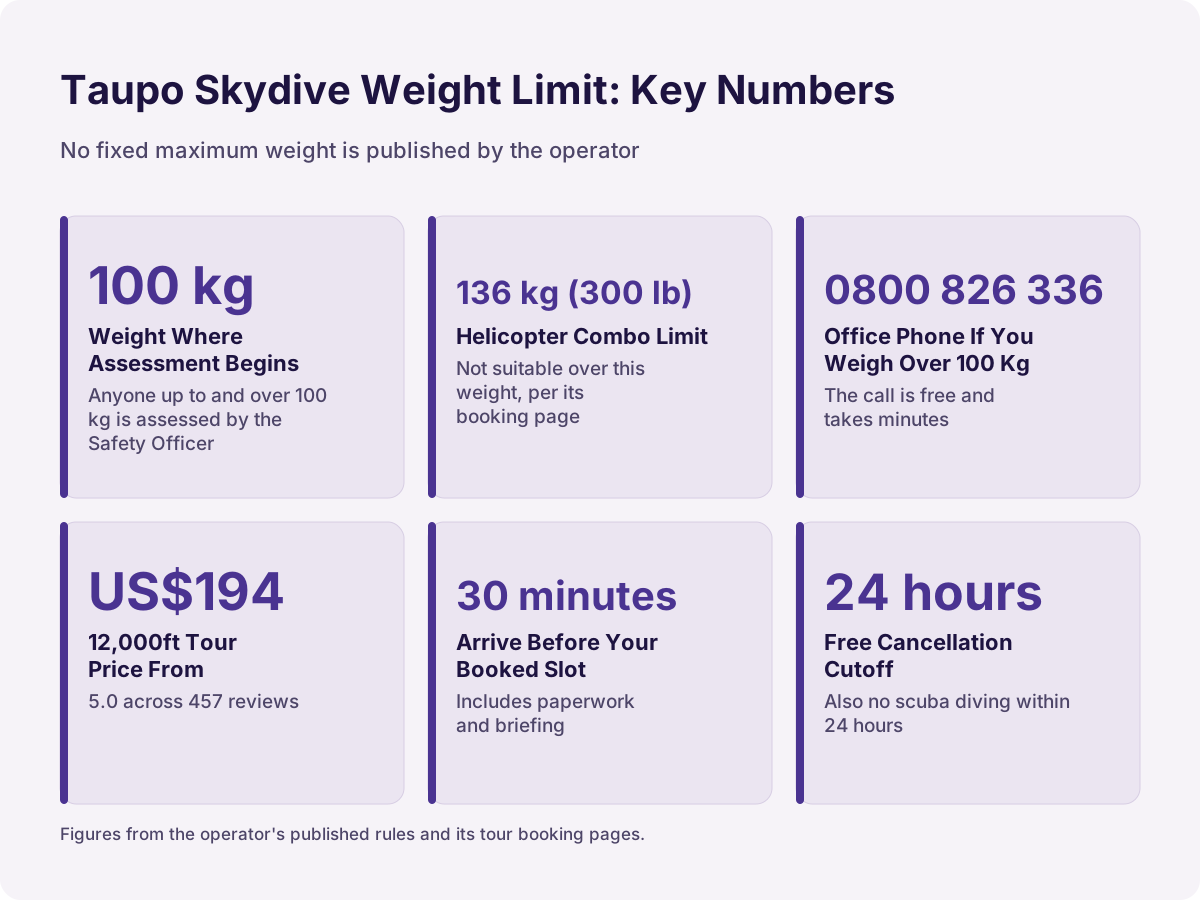
There is no fixed maximum weight for a Taupo tandem skydive. The operator assesses anyone up to and over 100 kg individually, and the helicopter combo carries its own separate limit.
Short answer
The Taupo operator states no fixed maximum weight. Limits come from equipment plus body shape and mobility, and anyone up to and over 100 kg is assessed individually by the Safety Officer. The Helicopter Flight, 15,000ft Skydive combo is different: its booking page says not suitable over 136 kg (300 lb).
Everything below unpacks those rules, why the operator works this way instead of publishing a single number, and what to ask so you never lose a booking to a surprise at check-in. For the wider picture on the jump itself, see what to expect at a Taupo skydive.
| Question | Answer |
|---|---|
| Fixed maximum weight for skydive-only tours | Not stated by the operator |
| Assessment point | Up to and over 100 kg, assessed individually by the Safety Officer |
| What the assessment considers | Equipment limits plus body shape and mobility |
| What to do if over 100 kg | Contact the office on 0800 826 336 |
| Helicopter combo limit | Not suitable over 136 kg (300 lb), per its booking page |
| Surcharges | None stated |
| Per-altitude weight limits | None stated |
What Is The Taupo Skydive Weight Limit?
There is no single published number. The operator, whose drop zone sits at 1227 Anzac Memorial Drive, Taupo Airport, says weight limits come from the equipment combined with each jumper's body shape and mobility. Anyone up to and over 100 kg is assessed individually by the Safety Officer rather than turned away at a fixed cutoff. If you weigh over 100 kg, the operator asks you to contact the office on 0800 826 336 before your jump.
That answer frustrates people who want a clean yes or no, but it reflects how tandem equipment actually works. A tandem harness, the attachments between student and tandem master, and the parachute system itself are rated for load, and how that load sits on a particular body matters as much as the number on the scale. Two people at the same weight can fit the harness very differently, which is why the operator's FAQ page frames the limit as an individual assessment rather than a flat rule.
What the operator does not publish matters too. There is no stated surcharge for heavier jumpers, and there are no per-altitude weight limits: the same assessment applies whether you book the 12,000ft Tandem Skydive or the higher 15,000ft Tandem Skydive. If a website or forum quotes you a hard weight number for Taupo, treat it with suspicion, because the operator's own pages say nothing of the sort.
The featured 12,000ft Tandem Skydive is the one tour here with a printed rating and price: 5.0 across 457 reviews, from US$194 per person, with free cancellation up to 24 hours before. None of those figures carry over to the other two tours. Check availability on that tour's booking page, and read more in the Taupo skydive reviews guide.
Why 100 Kg Is An Assessment Point, Not A Cutoff
The 100 kg figure in the operator's rules is where individual assessment begins, not where permission ends. The wording is deliberately open: jumpers "up to and over 100 kg" are assessed individually by the Safety Officer, which means people well above 100 kg do jump from Taupo when the equipment fits them. The only stated action for anyone over 100 kg is to contact the office on 0800 826 336 ahead of time.
Understanding why starts with the harness. Tandem equipment is sized and rated in bands, and the Safety Officer's job at the drop zone is to match the gear to the person in front of them. Body shape and mobility enter the equation because a jumper needs to lift their legs for landing, arch their body in freefall, and be secured so the harness cannot shift under load. The operator's terms and conditions and FAQ both describe the limit this way, and neither page prints a maximum.
The practical consequence for planning is that a pre-booking phone call does more than any amount of online reading. When you call, the office can talk through your height and weight together, which altitude you want, and whether the available harnesses on your date will fit. That call is free and takes minutes, and it removes the worst outcome: arriving at Taupo Airport, roughly a 10 minute drive from town, only to be assessed out on the day.
The three bookable tours all run through the same operator, so this assessment applies equally to the skydive-only options. If you are comparing altitudes, the 12,000 versus 15,000 ft comparison covers the trade-offs, and the weight question is identical across both.
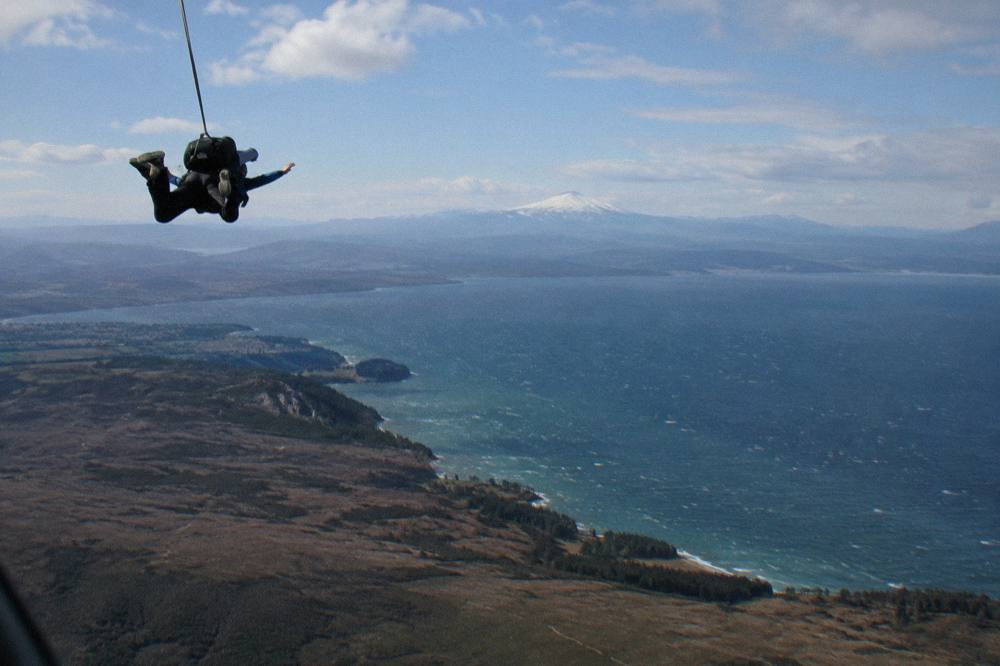
Whichever altitude you lean toward, the weight conversation with the operator comes first. Once the Safety Officer's assessment is settled in principle, the choice between a freefall of almost 40 seconds at 12,000 ft and a freefall of almost 60 seconds at 15,000 ft becomes a genuine preference call rather than a constraint.
A few minutes of preparation makes the call more useful for both sides. Weigh yourself close to the day you plan to book rather than relying on a figure from months ago, and know your height too, because the office reads the two numbers together rather than either one on its own. Two people at the same weight can sit very differently in the same harness depending on their frame, which is exactly why the rule is written as an assessment instead of a hard line. Have a date, or a shortlist of dates, in mind before you dial, since the real question is not whether the operator jumps with people over 100 kg in general, but whether a suitable harness is available on your specific day. If you already lean toward one altitude, say so on the same call, because the weight conversation and the altitude choice can then be settled together rather than across two separate exchanges.
The same preparation helps on the physical side. The three demands listed above, lifting your legs for landing, arching your body in freefall, and keeping the harness fixed under load, are things you can gauge honestly at home before you travel. If raising your legs while lying on your back is a struggle, or your shoulders and hips resist an arch, mention it on the call rather than leaving it to surface at the drop zone. This is not a self-test to pass or fail; it simply gives the office a fuller picture before you stand in front of them. Because the assessment is individual by design, the more specific the information you volunteer on the phone, the more closely the outcome on the day will match the one you planned around.
There is also a practical case for being exact rather than optimistic with your numbers. Because those bands are rated, what the office needs is your real weight, not the one that sounds better, and a small understatement shifts a decision that belongs to a trained assessor onto a guess made at the airport. The worst version of that gamble is the one already described, making the trip out only to be assessed out on the day, and it is entirely avoidable with a free call. Honesty also works in your favour in the other direction. If your weight sits near but under 100 kg, the same conversation confirms which harness band applies to you and removes any doubt before you travel. Treat the phone number in the same spirit as the rest of this guide: the fixed figures, the altitude choice, the drive from town, are all easy to plan from a desk, and the one variable that needs a human answer is the fit between you and the equipment, which is exactly what the call resolves.
How The Assessment Actually Works On The Day
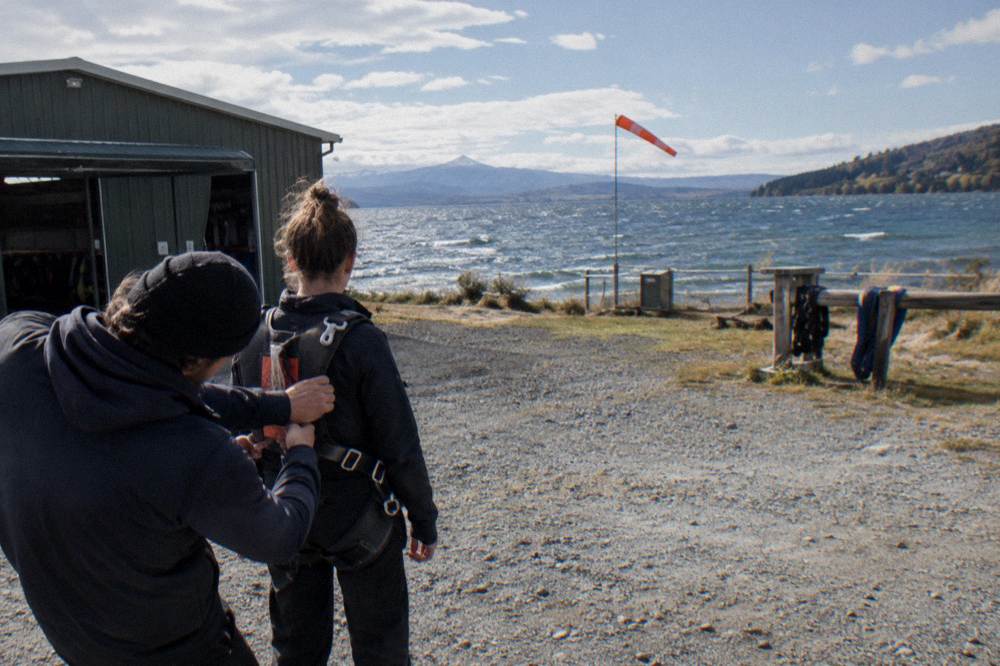
On jump day the Safety Officer looks at three things together: your weight, how the harness fits your body, and whether you can move as the jump requires. Payment is taken after the jump, and the operator may decline a jump for safety, which is why raising weight questions before you travel matters. There is no weigh-in ritual described in the operator's pages beyond the sign-in process, which starts 30 minutes before your booked time.
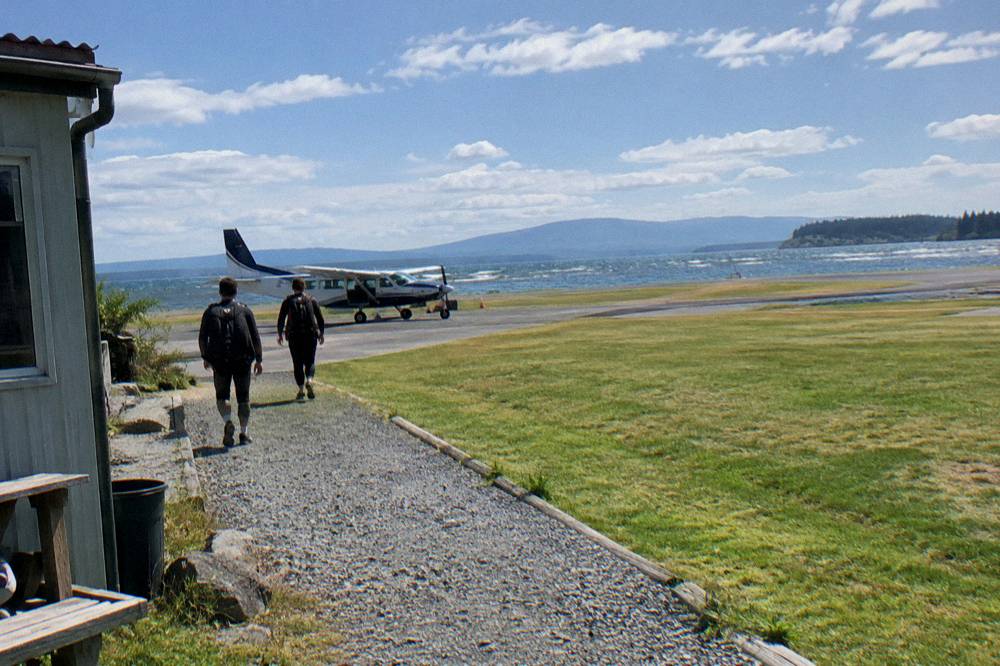
The operator's stated check-in process asks jumpers to arrive 30 minutes before the booked slot to sign in. That window includes paperwork and briefing, and it is when any individual assessment happens in practice. The equipment considerations are the operator's to manage, but your mobility is worth preparing honestly: the tandem master will brief the body position, and the harness needs to be snug across hips and shoulders in a way that depends on your build rather than just your weight.
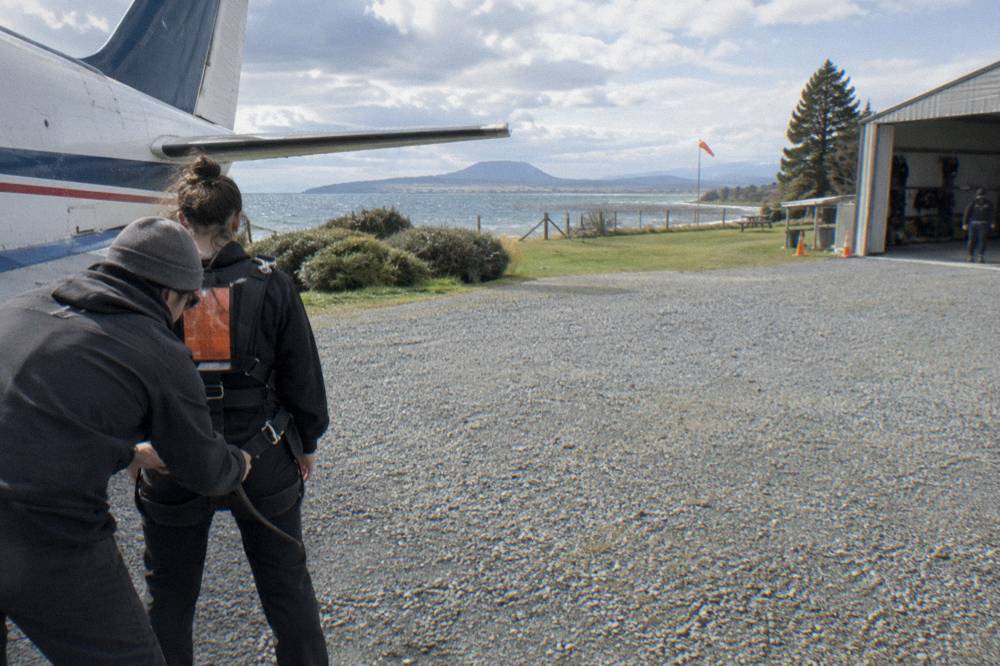
It helps to know what else sits beside the weight rules at check-in. Government photo ID is required, and the medical rules are plain: see a doctor first if you have health concerns, no scuba diving within 24 hours, and no drugs or alcohol. The operator publishes no condition-by-condition list, so anything specific to your situation is a question for the office on 0800 826 336, not something to assume from other skydive centres' rules.
One reassurance for heavier jumpers weighing the decision: the operator says it has been running tandem jumps for over 25 years and more than 200,000 jumpers, with tandem masters tested by the NZ Parachute Industry Association, and its Safety Management System certified by the Civil Aviation Authority. Those are the operator's own statements, and they describe a drop zone used to assessing all kinds of bodies, not a boundary looking for reasons to say no.
The Helicopter Combo's Separate 136 Kg (300 Lb) Rule
The Helicopter Flight, 15,000ft Skydive combo is the one product here with a stated maximum weight: its booking page says it is not suitable for anyone over 136 kg (300 lb). That limit belongs to the combo alone, because the helicopter part is flown by a separate helicopter company. It never applies to the 12,000ft or 15,000ft Tandem Skydive tours, which have no stated maximum.
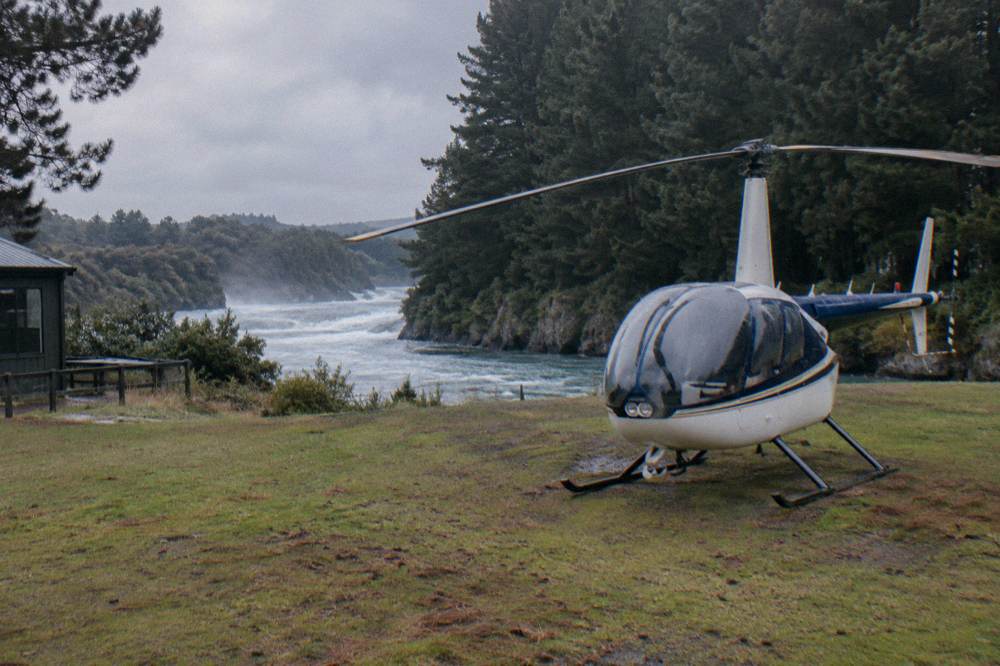
The combo is a different machine, literally. A 12 minute helicopter flight from the Huka Falls area precedes the 15,000 ft jump, and helicopters have payload limits of their own, which is why the booking page for this product carries a hard number where the skydive-only tours carry an assessment. The operator's combo page gives the operator's side of the package: from NZ$599 per person with a minimum of two passengers, a free exit photo, and the option to upgrade to 16,500 ft at the drop zone.
| Product | Weight Rule | Where It Comes From | Free Cancellation |
|---|---|---|---|
| 12,000ft Tandem Skydive | No fixed maximum; assessed individually up to and over 100 kg | Operator FAQ and terms | Yes, 24 hours |
| 15,000ft Tandem Skydive | No fixed maximum; assessed individually up to and over 100 kg | Operator FAQ and terms | Not stated |
| Helicopter Flight, 15,000ft Skydive | Not suitable over 136 kg (300 lb) | Combo booking page | Yes, 24 hours |
| Operator's 9,000 ft option (direct) | No fixed maximum; assessed individually up to and over 100 kg | Operator FAQ and terms | Not stated |
| Operator's 16,500 ft option (direct) | No fixed maximum; assessed individually up to and over 100 kg | Operator FAQ and terms | Not stated |
If you are between 100 and 136 kg, the combo may still be open to you while the skydive-only tours go through their individual assessment, so treat the two questions separately. If you are over 136 kg and set on the combo, the booking page leaves no room to negotiate; the skydive-only routes remain the ones to discuss with the office. The full package details are in the Taupo heli and skydive combo guide.
The combo is new on the booking pages and carries no rating yet, which is worth knowing if review history matters to your decision. The two skydive-only tours are the established products, and only the 12,000ft Tandem Skydive has a printed rating at all. The wider set of guides lives on Taupo Tandem Skydive.
What To Ask The Operator Before You Book
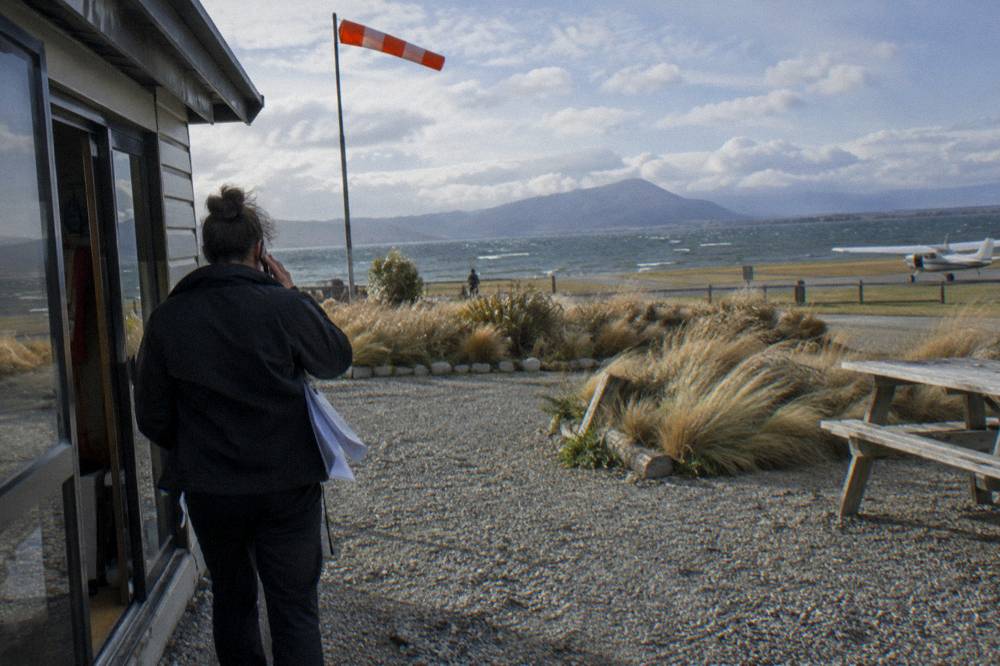
One phone call to 0800 826 336 settles everything this article cannot: whether the harnesses available on your date fit you, which altitudes are realistic, and what the Safety Officer will want to know. Ask your exact weight and height together, mention any mobility considerations, and confirm the altitude you want before you pay anything.
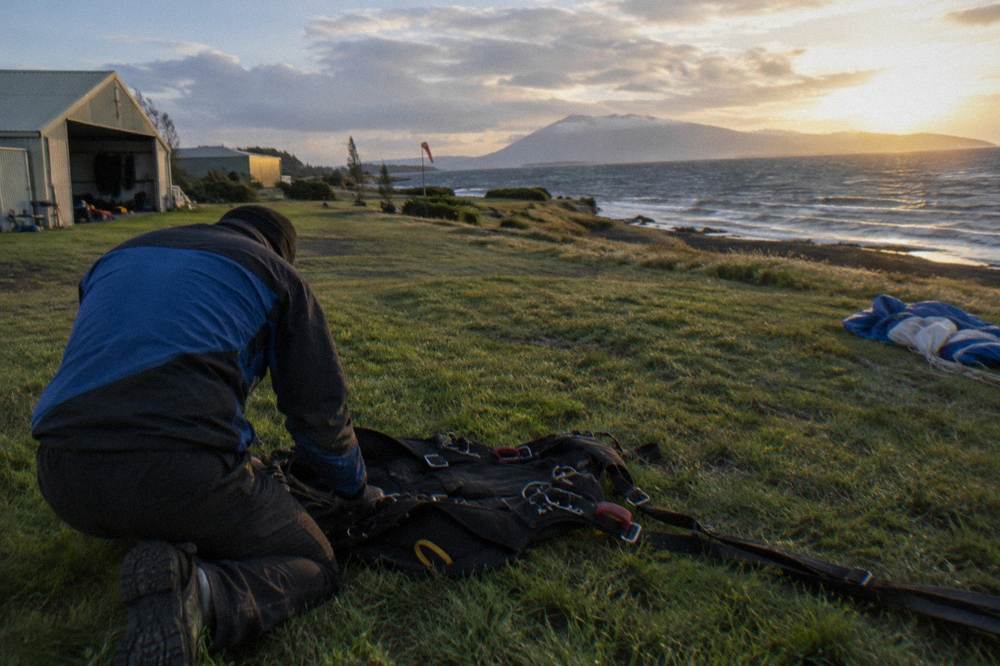
Specific questions get specific answers. Your weight alone tells the office little; your weight with your height, and honest notes on mobility, let them judge harness fit properly. If you are eyeing the 15,000ft Tandem Skydive, ask directly about it, because that tour's booking page states no price, no duration and no rating, and the operator's own price page lists NZD 379 for the 15,000 ft jump as the operator's figure. Ask also about photo packages at the same time if media matters to you, since camera add-ons are priced separately from the jump.
| What To Ask | Why It Matters | Where The Rule Comes From |
|---|---|---|
| "I weigh X kg and I'm Y cm tall, which jumps work for me?" | The assessment uses weight, body shape and mobility together | Operator FAQ and terms |
| "Will a harness fit me on my date?" | Harness stock on the day decides, not a fixed rule | Operator FAQ |
| "Does the 15,000 ft jump cost anything beyond NZD 379?" | Camera packages and holiday surcharges are separate | Operator price page |
| "Is the combo an option at my weight?" | The combo's 136 kg limit is a hard booking-page rule | Combo booking page |
| "What happens if weather cancels my jump?" | Rebooking or free cancellation if you cannot return | Operator FAQ |
Two cost details from the operator's price page belong in any booking conversation. A 15% surcharge applies to the skydive on New Zealand public holidays, though not to photo or video packages, and card payments carry a 1.5% surcharge. Neither is a weight matter, but both change what you actually pay, and the phone call is the moment to hear the full picture.
The 24 hour free-cancellation policy on the 12,000ft Tandem Skydive gives extra room here: book the featured tour, make the confirmation call, and still have a window to withdraw if the assessment answer changes your plans. Later cancellation or a no-show may be charged in full, so the earlier call always beats the later one.
Age, Health And ID Rules That Sit Beside The Weight Rules
Weight is only one gate at check-in. The operator sets a minimum age of 8 with no upper age limit, requires written parental consent for anyone under 18, individually assesses jumpers under 14, restricts 16,500 ft to ages 14 and over, and requires government photo ID from everyone. Medical rules are short: see a doctor first if unsure, no scuba diving within 24 hours, and no drugs or alcohol.
These rules travel with the weight assessment, because the Safety Officer's decision on the day takes the whole person. The under-14 rule is the most unusual: a child under 14 is assessed individually and must be accompanied in the plane by an adult they know who is also paying for a skydive. At the other end of the range, the operator mentions a 95 year old jumper, which gives a sense of how open the upper limit is in practice.
On health, the operator publishes no list of conditions that rule a jump out, and inventing one from other drop zones' rules would mislead. If you have a heart condition, an eye issue, are pregnant, or take medication, the stated path is the same: see a doctor first, then raise it with the operator on 0800 826 336, which may decline a jump for safety on its own judgment. Glasses wearers get one firm answer at least: glasses fit under the supplied goggles, and the operator supplies the jumpsuit, goggles, hat and neck buff, so you only need warm comfortable clothes and closed-toe shoes.
Families working through these rules together have more ground to cover, and the skydiving with teenagers and families guide lays it out. The essentials for this page are simple: weight, age, health and ID are assessed at the same desk, so raise all four in the same phone call.
What Trips People Up When Checking Weight Limits
Most weight-limit problems come from three habits: trusting a number quoted on a forum instead of the operator's own assessment rule, assuming the combo's 136 kg limit applies to every jump, and booking first without the phone call that would have settled the fit question. Each mistake is avoidable with one call to 0800 826 336 before payment.
Weight Rules At A Glance No fixed maximum weight is published for the skydive-only tours; jumpers up to and over 100 kg are assessed individually by the Safety Officer.
The forum-number trap is the most common. Search results for Taupo weight limits surface plenty of confident figures, but the operator's own FAQ and terms pages state an individual assessment with no maximum, and those are the only rules that count at the drop zone. If a third-party site quotes a cutoff, it is describing some other drop zone or an outdated page, and the jumper who trusted it either needlessly writes off their jump or arrives unprepared for a question they should have asked.
The second trap transfers the combo's rule backwards. Because the 136 kg (300 lb) figure is the only hard number any Taupo product states, it circulates as if it were the general limit. It is not. It belongs to the helicopter combo's booking page alone, and applying it to the 12,000ft or 15,000ft Tandem Skydive wrongly rules out people the Safety Officer may happily jump.
The third trap is silence. A jumper over 100 kg who says nothing, books, and turns up hoping for the best leaves the assessment to the busiest possible moment. The office prefers the call, the harness question gets answered with real stock in mind, and the 24 hour free-cancellation window on the featured tour means an honest answer early costs nothing. Families should also remember the parallel rules: ID, consent forms for under 18s, and the under-14 accompaniment rule all surface at the same check-in desk.
Common Questions About The Taupo Skydive Weight Limit
Is There A Maximum Weight For Skydiving In Taupo?
The operator states no fixed maximum. Weight limits come from equipment plus body shape and mobility, and anyone up to and over 100 kg is assessed individually by the Safety Officer. If you weigh over 100 kg, contact the office on 0800 826 336 before booking.
Is There A Weight Surcharge For The Taupo Skydive?
No surcharge is stated on any of the operator's pages. Surcharges that do exist apply elsewhere: 15% on the skydive on New Zealand public holidays, and 1.5% on card payments.
Does The Helicopter Combo Have A Different Weight Limit?
Yes. The combo's booking page says it is not suitable over 136 kg (300 lb), and that limit belongs to the combo alone because the helicopter flight is run by a separate helicopter company. The skydive-only tours have no stated maximum.
What Should I Tell The Operator When I Call About Weight?
Give your weight and height together, describe any mobility considerations honestly, and name the altitude or product you want. That lets the office judge harness fit and whether the date works before any money changes hands.
Do The Weight Rules Change With Altitude?
No per-altitude weight limits are stated. The same assessment process applies to the 12,000ft and 15,000ft Tandem Skydive tours, and to the operator's own 9,000 and 16,500 ft options booked direct.
Can The Operator Refuse A Jump On The Day?
Yes. The operator's terms say it may decline a jump for safety, which is one reason to settle the weight question by phone beforehand. Payment is taken after the jump, and a weather hold means rebooking or free cancellation if you cannot return.