How Long Does A Taupo Skydive Take From Check-In To Landing?
The operator gives three different duration statements, and each one answers a different question. Here is what they mean, and how to budget a day around them.
Short answer
The operator says a Taupo tandem skydive is finished in about 2 hours from start to finish, while its FAQ says to allow 2 to 3 hours and its terms say 3 hours. The skydive portion itself is about 30 minutes, and you should arrive 30 minutes before your booked time to sign in. Trips run hourly from 8:00 to 18:00 in summer and 9:00 to 16:00 in winter.
For the wider picture of jumping here, start with the guide to skydiving in Taupo.
| Question | Answer |
|---|---|
| Skydive portion | About 30 minutes, operator-stated |
| Whole visit | Finished in about 2 hours, operator FAQ |
| Time to allow | 2 to 3 hours (FAQ) or 3 hours (terms and conditions) |
| Arrival | 30 minutes before your booked time, to sign in |
| Tour page figure | 2 hours, on the 12,000ft Tandem Skydive page |
| Schedule | Hourly trips, 8:00 to 18:00 summer, 9:00 to 16:00 winter |
| Operating days | 362 days a year, operator-stated |
| Drop zone | 1227 Anzac Memorial Drive, Taupo Airport |
| Phone | 0800 826 336 |
From check-in to walking off the drop zone, a Taupo skydive typically takes about 2 hours, though the operator's FAQ says to allow 2 to 3 hours and its terms and conditions say 3 hours as planning buffers. Within that window, the skydive itself lasts about 30 minutes, and check-in begins 30 minutes before your booked time.
The three statements come from different pages answering different questions, and reading them as one ladder of numbers is the fastest way to misjudge your day. The "about 2 hours" figure on the operator's FAQ page describes how long a visit typically runs once you are checked in and jumping. The "allow 2 to 3 hours" wording on the same page, and the firmer "3 hours" in the terms and conditions, are there so you do not book a tight connection straight after your jump slot.
Nothing in the operator's material breaks the visit into flight-to-altitude minutes or minutes under the canopy, and no such numbers should be invented from other sources. What the operator does state is that the skydive portion is about 30 minutes and that the whole experience is finished in about 2 hours. The gap between those two figures is ground time: signing in, the safety briefing, gearing up, waiting for your load, and the post-jump wind-down.
The 12,000ft Tandem Skydive tour page carries its own figure, a flat 2 hours, which sits neatly alongside the operator's FAQ statement. Treat that as the anchor number for planning: block two hours, keep a third hour soft, and you have covered every version the operator publishes.
What Does The 30-Minute Skydive Portion Actually Cover?
The roughly 30-minute skydive portion is the operator's own description of the jump cycle itself, not the whole visit and not the freefall. The operator states no separate minutes for the ride to altitude, the freefall or the canopy ride, so no breakdown of that half hour exists in print. Everything before it, signing in, briefing and gearing up, and everything after, happens outside that window and inside the roughly 2 hour total.
This is the figure people most often misread. A 30-minute skydive portion does not mean 30 minutes of freefall, and it does not mean you are on site for only 30 minutes. It is the operator's shorthand for the block of time that contains your actual jump experience, and the operator gives no finer split than that.
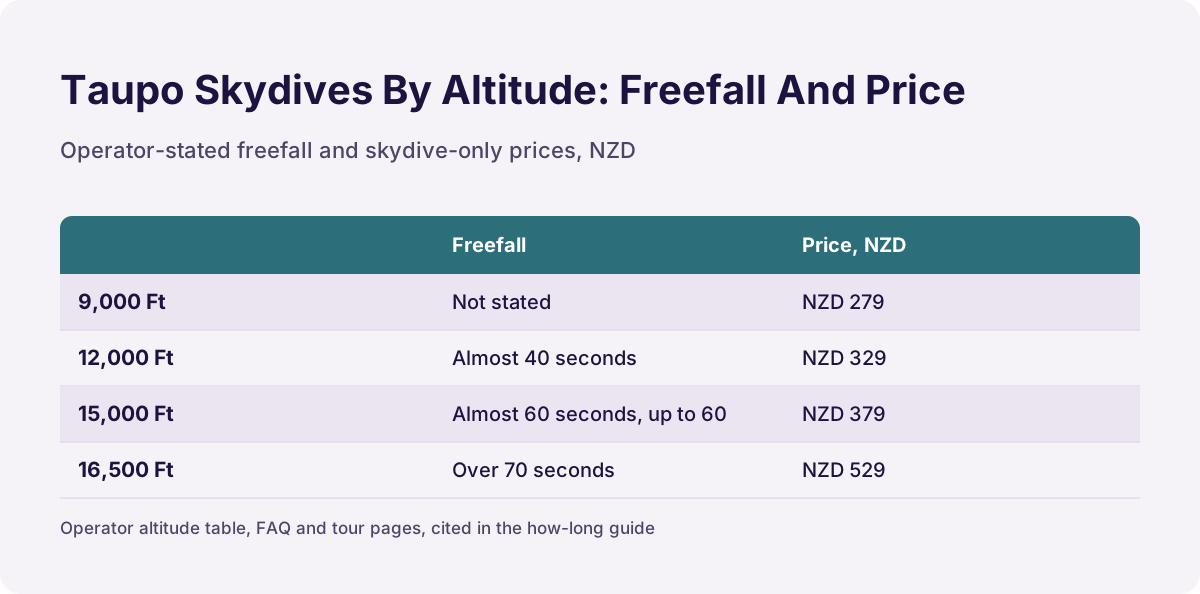
The freefall itself is described in seconds, not minutes, and only at three altitudes: 12,000 ft gives almost 40 seconds, 15,000 ft gives almost 60 seconds (the operator also says up to 60), and 16,500 ft gives over 70 seconds. The 9,000 ft freefall time is not printed because the operator's own page gives two different numbers for it, so treat that as a question for the drop zone rather than a fact to plan around.
“They have to do it. Nathan was awesome he made you feel comfortable would I do it again hell yes thank you for the experience”
For first-timers wanting the fuller walkthrough of the day, the what to expect on a Taupo skydive guide covers the sequence in detail, and the questions around how high a Taupo skydive goes explain the altitude ladder those freefall seconds attach to.
If you are weighing which booked experience fits your clock, the three bookable options pull in different directions: the established 2 hour jump, the higher-altitude ride with no stated duration, and the helicopter combo that adds a 12-minute flight in front.
Does A Higher Altitude Take Longer On The Day?
The operator states no per-altitude duration, so there is no printed answer to whether 15,000 ft takes longer on the ground than 12,000 ft. What does change with altitude is the freefall: almost 40 seconds at 12,000 ft, almost 60 seconds at 15,000 ft and over 70 seconds at 16,500 ft. The roughly 2 hour visit and the about 30-minute skydive portion are operator-wide statements, not altitude-specific ones.
This is where planning guides usually go wrong. It is tempting to build a table of durations by height, and just as tempting to claim ground time does not change with altitude. Neither statement appears in the operator's material. The durations in print, about 2 hours finished, 2 to 3 hours allowed, 3 hours in the terms, about 30 minutes for the skydive portion, are stated for the operation as a whole.
What can be compared honestly is the freefall ladder and the prices, both of which the operator states per height:
| Altitude | Freefall, operator-stated | Skydive-only price, NZD |
|---|---|---|
| 9,000 ft | Not stated | NZD 279 |
| 12,000 ft | Almost 40 seconds | NZD 329 |
| 15,000 ft | Almost 60 seconds, up to 60 | NZD 379 |
| 16,500 ft | Over 70 seconds | NZD 529 |
The 12,000ft Tandem Skydive is the one option with a full printed set: 5.0 across 457 reviews, from US$194, a 2 hour duration on the tour page and free cancellation up to 24 hours before. The 15,000ft Tandem Skydive carries no stated rating, review count, price or duration on its booking page, so budget for it using the operator-wide figures rather than assuming a longer day. The choice between the two heights is covered properly in the 12,000 vs 15,000 ft comparison.
The 16,500 ft option exists too, but only through the operator directly: there is no separate booking card for it, it is restricted to ages 14 and over, and it needs a high-altitude waiver signed at the drop zone. The operator also says it may adjust the exit height slightly.
How Long Does The Helicopter Combo Take?
No total duration is stated for the helicopter combo. The operator's combo page describes a 12-minute helicopter flight followed by a 15,000 ft skydive with freefall of up to 60 seconds, on a schedule of a 1pm helicopter and a 2pm skydive. That is the only timing in print: the pages give no start-to-finish figure for the combined day.
The combo runs differently from the skydive-only visits, and the timing shows it. You start from the Huka Falls area rather than the airport drop zone: the booking page gives 415 Huka Falls Road, Wairakei as the start point, while the operator's combo page says flights leave from Huka Falls Heliport. The helicopter part is flown by a separate helicopter company, and the skydive is the same operator's 15,000 ft jump.
| Skydive-only visit | Helicopter combo | |
|---|---|---|
| Stated duration | About 2 hours finished, 2 to 3 hours allowed | No total stated |
| Stated components | Skydive portion about 30 minutes | 12-minute helicopter flight, then 15,000 ft jump |
| Schedule | Hourly trips, 8:00 to 18:00 summer, 9:00 to 16:00 winter | 1pm helicopter, 2pm skydive |
| Start point | 1227 Anzac Memorial Drive, Taupo Airport | 415 Huka Falls Road, Wairakei, per the booking page |
| Photos and video | Paid camera packages | Included per the booking page; free exit photo per the operator |
| Cancellation | 24-hour free cancellation on the 12,000ft tour | Free cancellation 24 hours, per the booking page |
If the combo appeals, plan it as an afternoon built around the fixed 1pm and 2pm schedule rather than a drop-in hourly slot. The full detail is in the Taupo heli and skydive combo guide.
How Do Weather Holds Affect Your Timing?
Weather decides whether a jump runs, and the operator's system is built around that: call 30 minutes before arrival or pickup to confirm conditions. A weather hold means rebooking the same day or a later day, or cancelling free if you cannot come back. Payment is taken after the jump, which is why the operator can afford to be relaxed about rebooking.
The 30-minute call is the single most useful timing habit on this page. The operator runs hourly trips, so a hold does not necessarily end your day; a later load the same day is often possible. The operator states no wind or cloud thresholds, so there is no point trying to forecast the decision yourself.
For prepaid bookings the rules are spelled out: prepaid weather cancellations may be refunded, excluding booking and card fees, and gift vouchers are not cash-refundable. A refund for a prepaid-direct booking comes via the operator, otherwise via whoever you booked through. The mechanics of all this are unpacked in the weather and cancellations guide.
The practical time lesson: keep the last hour of your stated window soft. If your slot is late morning, a weather hold can still mean an afternoon jump. If your slot is the last of the day, a hold almost certainly means another day, which matters if Taupo is a one-night stop.
When Should You Arrive And How Do You Get There?
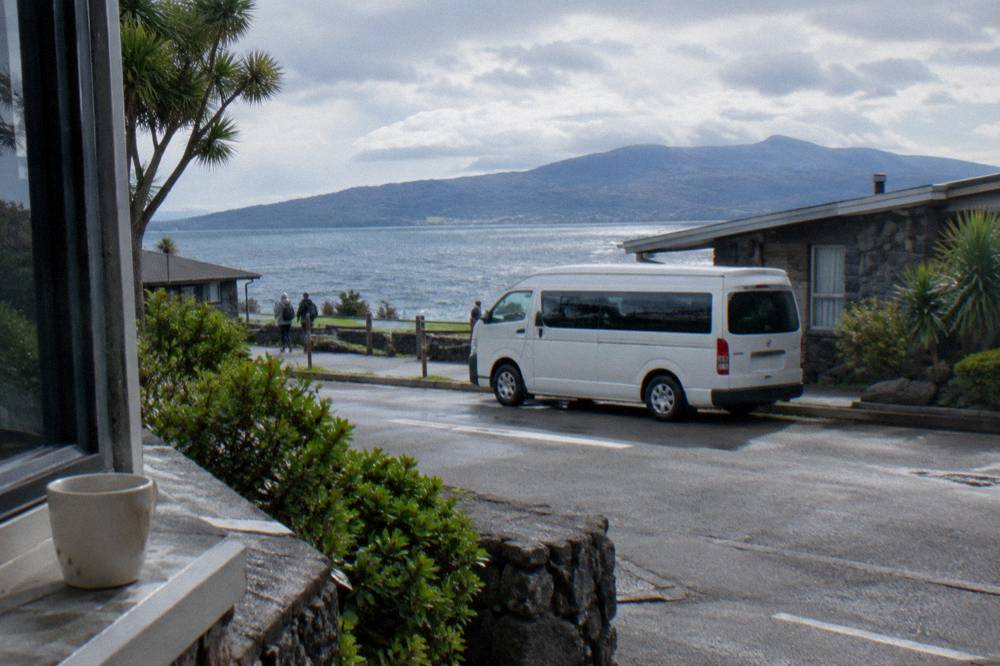
Arrive 30 minutes before your booked time to sign in, per the operator's terms. The drop zone sits at 1227 Anzac Memorial Drive, Taupo Airport, which the operator calls just a 10 minute drive from town. Free transport within Taupo, a stretch Hummer or minibus, runs about 30 minutes before your booked time, so being ready at your accommodation half an hour early covers both the pickup and the sign-in.
The transport detail is the one that quietly wrecks tight schedules. The pickup happens roughly 30 minutes before your booked jump time, and you are still expected at the drop zone 30 minutes before that same time to sign in, so the shuttle and the check-in window run in parallel for in-town guests rather than in sequence. Being at your pickup point on time is what makes the rest of the arithmetic work.
Rotorua pickup exists but for groups only, and it does not run on NZ public holidays. The operator's pages disagree on the group minimum, so treat the number as something to ask directly on 0800 826 336. Parking at the airport is not stated either way; ask the operator if you are driving yourself.
One naming trap: the same operator also answers at skydivetaupo.co.nz. It is the same business, not a competitor and not a second option, so a booking made through either door lands at the same drop zone on the same schedule. The meeting point and getting there guide covers the geography in full.
Can You Fit A Taupo Skydive Into Half A Day?
Yes, with the operator's own numbers as the budget: 30 minutes of shuttle or arrival buffer, about 30 minutes of skydive portion, and roughly 2 hours on site in total, with 2 to 3 hours as the safe allowance. Morning and afternoon both work because trips run hourly from 8:00 to 18:00 in summer and 9:00 to 16:00 in winter, and the operator runs 362 days a year.
The honest version of a half-day plan leaves room for the weather call. Book a morning slot, make the confirmation call 30 minutes ahead, and you still have the afternoon for everything else in Taupo, from Huka Falls to the lakefront. Book the last slot of the day and a hold costs you the day, which is the real argument for going early rather than any claim about morning conditions, since the operator states none.
For a full itinerary built around these numbers, the Taupo skydive day plan lays out a workable schedule, and the best time to skydive in Taupo guide covers the seasonal picture without inventing weather statistics.
The combo is the one option that resists the half-day squeeze, because its 1pm helicopter and 2pm skydive schedule fixes your afternoon. With no total duration stated for it, treat it as a commitment of the whole afternoon, not a jump you can sandwich between other bookings.
“I had an amazing skydiving experience with you today, June 19, 2025! The 12,000-ft jump, professional guides, and seamless hotel pick-up and drop-off were outstanding. Thank you for an unforgettable adventure!”
Common Mistakes When Planning Your Time
The mistakes that cost people their day are simple ones: adding the operator's duration statements together, assuming altitude changes the ground time, skipping the 30-minute confirmation call, and booking the last slot of the day on a tight itinerary. Each mistake comes from treating a planning buffer or a single statement as a hard schedule. None of the operator's numbers is a promise, because weather always decides whether a jump runs.
Adding the numbers up is the classic error. About 2 hours, plus 2 to 3 hours, plus 30 minutes early, plus a 30-minute skydive portion does not equal four and a half hours; the first two figures describe the same visit, the third is inside them, and only the arrival buffer sits outside. Budget two hours plus a soft third hour and you have used every statement correctly.
The second error is assuming the 15,000ft or 16,500 ft options need a longer day. No per-altitude duration is stated anywhere; the roughly 2 hour visit and the about 30-minute portion apply operator-wide, and only the freefall seconds change with height.
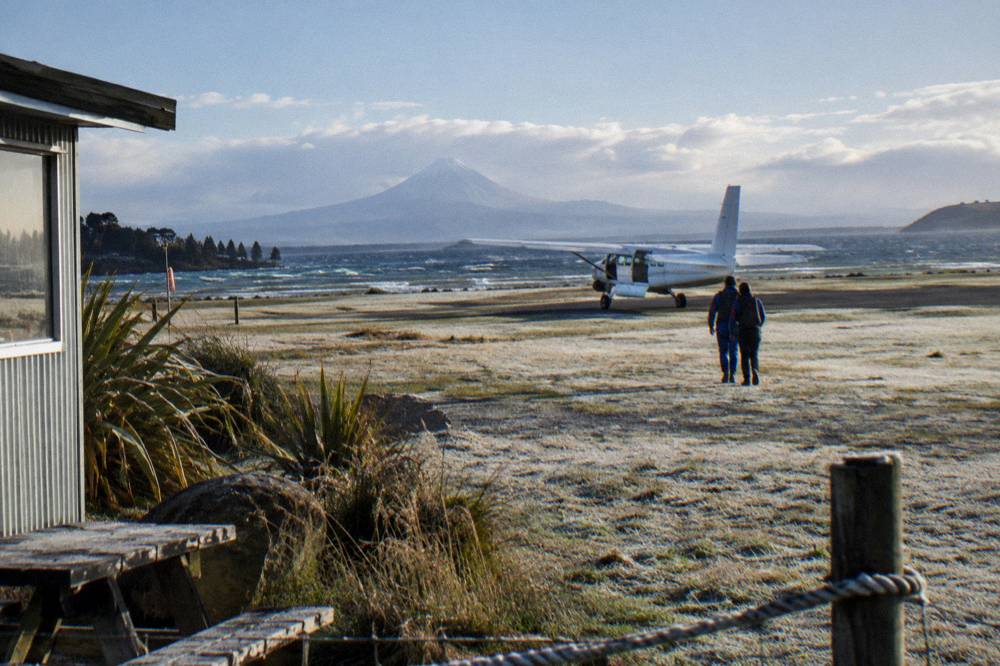
The third is ignoring the phone. The operator asks you to call 30 minutes before arrival or pickup to confirm the weather, and that call is what turns a wasted drive into a quick rebooking. The fourth is booking the final load of the day and expecting a same-day rebooking window that no longer exists. And a quiet fifth: turning up without government photo ID, which the operator requires, slows your check-in whatever the clock says.
Whether you land on the established 12,000ft Tandem Skydive with its printed 2 hours, the higher 15,000ft ride, or the afternoon-long helicopter combo, the timing logic on this page is the same: block the time the operator states, keep an hour soft, and let Taupo Tandem Skydive adjust the rest if the sky has other ideas.
The practical fix for the arithmetic problem is to plan backwards from the block rather than forwards from your alarm clock. Anchor the day on the printed two hours, add the soft third hour, and place the 30-minute phone call immediately before you set off for the airfield or the pickup point. That sequencing is what makes the call useful: a weather confirmation means you travel with your arrival buffer untouched, while a weather no means you have spent one phone call instead of a wasted drive. Keep your government photo ID somewhere reachable, in a pocket or a day bag rather than locked in the car, because check-in runs on the same clock you have just protected, and hunting for documents at the counter eats the buffer you were careful to keep. If you have a second booked activity the same day, leave the soft hour empty on purpose. Good weather hands you an unplanned hour; a late load costs you nothing but the hour you had already written off. Log the visit once in your itinerary rather than once per statement, and the arithmetic problem stays solved.
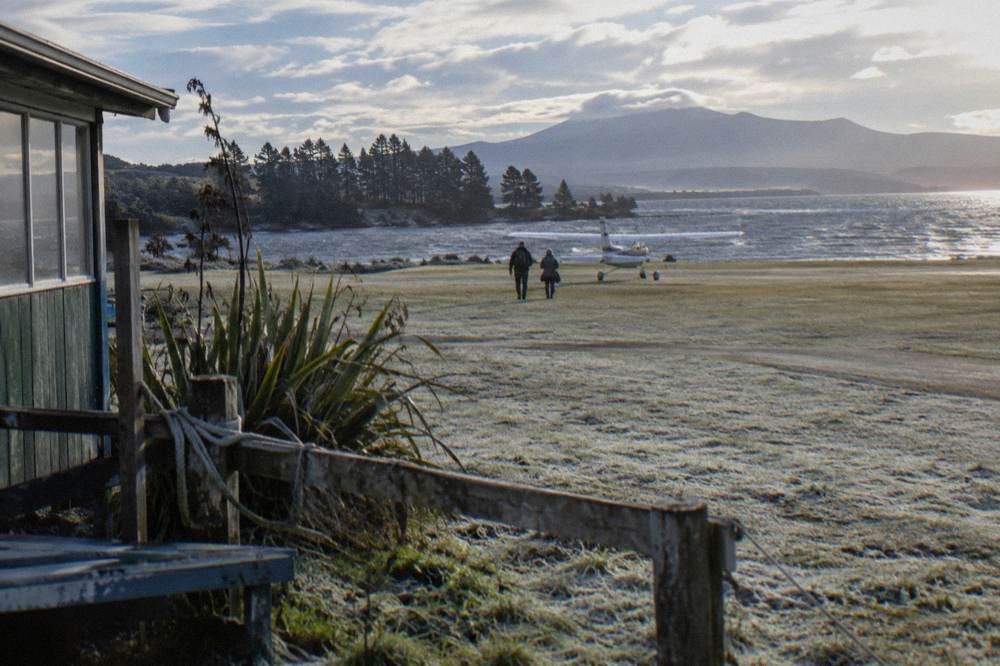
This discipline doubles as a self-check once your plan is written down. Count the time entries on the page: there should be one block for the visit, one soft hour held open behind it, one arrival buffer folded into the front of the block, and one phone call that costs nothing but attention. If the skydive portion shows up as its own appointment, or your chosen altitude appears to add a second block, the page has caught the classic error for you, and you can strike the duplicate line. A plan that reads one visit, one soft hour, one call is the timing logic applied correctly; anything longer on paper is arithmetic, not logistics. The same test works whichever product you booked, because the visit length does not change between the altitude tiers.
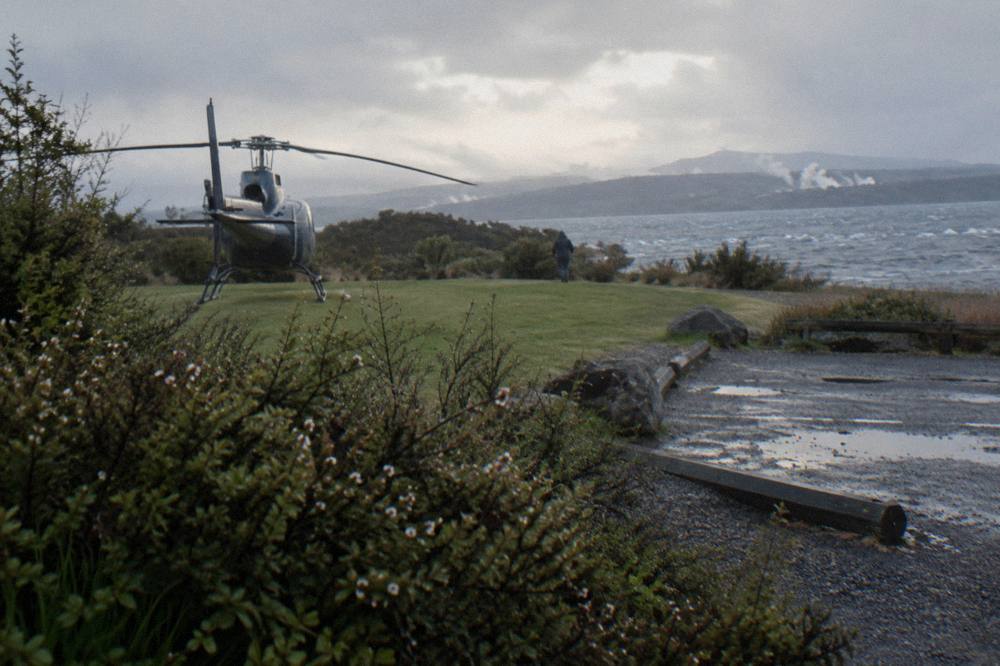
Choosing between the 12,000ft, 15,000ft, and 16,500ft rides settles itself once the timing question is out of the way. No per-altitude duration exists in the operator's material, so height changes only the freefall seconds inside the same visit, and the decision becomes a preference about the jump itself rather than a scheduling problem. The helicopter combo is the one product with a different shape: it is the afternoon-long option, so the block you anchor on is longer, but nothing else about the method moves. Block what the operator states, keep an hour soft, place the call before you travel, and carry your government photo ID somewhere that does not send you walking back to the car.
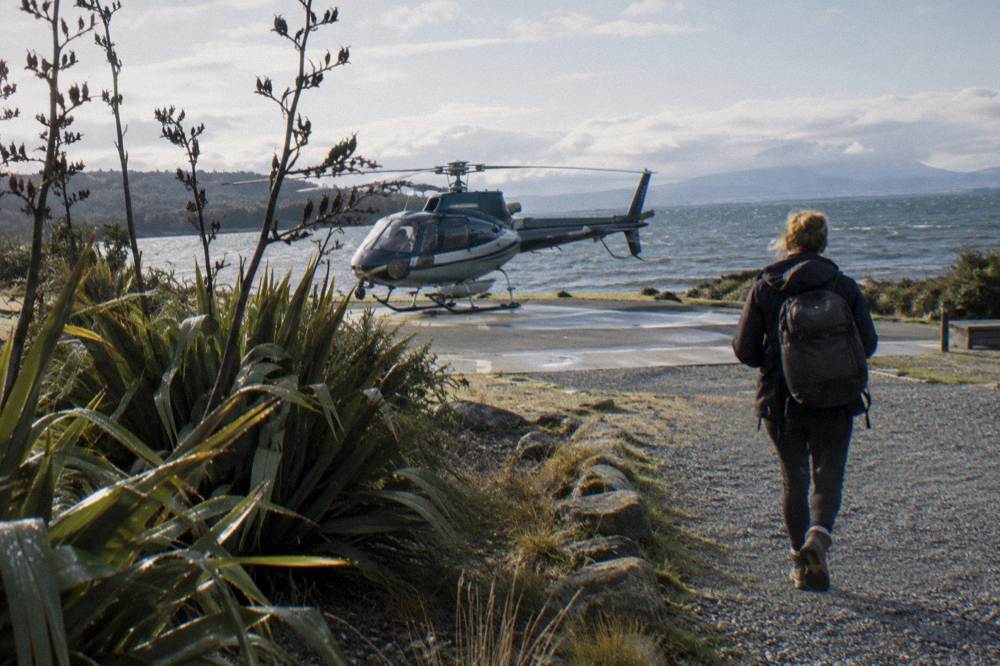
It also helps to see the protections as layers, because each one covers a different loss. The confirmation call protects the drive: it is the single point in the day when the weather is checked against your plans before you commit road time. The soft hour protects the schedule: it is time you have already agreed to write off, so a delay inside the visit takes nothing you were counting on. Reachable ID protects check-in: the operator requires government photo ID, and a document hunt at the counter is the one delay none of the other layers can absorb. What no layer can fix is the last load of the day, because the same-day rebooking window has closed by then. A weather no on the final slot ends the day rather than rearranging it, so if your itinerary has nothing after the jump, take an earlier slot and let the soft hour do its quiet work.
Common Questions About How Long A Taupo Skydive Takes
How Long Does A Taupo Skydive Take?
The operator says the visit is finished in about 2 hours, its FAQ says to allow 2 to 3 hours, and its terms and conditions say 3 hours. The skydive portion itself is about 30 minutes, and you arrive 30 minutes before your booked time to sign in. The 12,000ft Tandem Skydive tour page states 2 hours.
How Many Minutes Of Freefall Do You Get?
Freefall is measured in seconds, not minutes. The operator states almost 40 seconds at 12,000 ft, almost 60 seconds (up to 60) at 15,000 ft and over 70 seconds at 16,500 ft. No freefall time is stated for 9,000 ft, so ask the operator on 0800 826 336.
Does A 15,000 Ft Jump Take Longer Than A 12,000 Ft Jump?
The operator states no per-altitude duration. The roughly 2 hour visit and the about 30-minute skydive portion are operator-wide figures, so plan the same time budget for both; only the freefall seconds differ.
How Long Does The Helicopter Combo Take?
No total duration is stated. The operator describes a 12-minute helicopter flight followed by a 15,000 ft skydive, on a schedule of a 1pm helicopter and a 2pm skydive. Treat it as a full afternoon commitment.
When Should You Arrive At The Drop Zone?
Arrive 30 minutes before your booked time to sign in, and call 30 minutes before arrival or pickup to confirm the weather. The free in-Taupo shuttle, a stretch Hummer or minibus, runs about 30 minutes before your booked time.
How Often Do Skydive Trips Run In Taupo?
Trips run hourly, from 8:00 to 18:00 in summer and 9:00 to 16:00 in winter, and the operator says it operates 362 days a year. The months for each season are not defined on the operator's pages.