How High Is A Taupo Skydive? Altitudes, Freefall And Canopy Time
Taupo skydives come in four heights, 9,000, 12,000, 15,000 and 16,500 ft, and the height you pick changes the freefall, the price, the age floor and even which camera packages are available. Here is what the operator states for each altitude, and how to choose.
Short answer
A Taupo skydive runs from 9,000 ft to 16,500 ft above the drop zone at Taupo Airport. The operator states freefall of almost 40 seconds at 12,000 ft, almost 60 seconds at 15,000 ft and over 70 seconds at 16,500 ft. Skydive-only prices run from NZD 279 at 9,000 ft to NZD 529 at 16,500 ft.
For the wider picture on the drop zone, see the guide to skydiving in Taupo.
| Fact | Detail |
|---|---|
| Heights offered | 9,000 / 12,000 / 15,000 / 16,500 ft |
| Freefall (operator-stated) | 12,000 ft: almost 40 s; 15,000 ft: almost 60 s; 16,500 ft: over 70 s; 9,000 ft: not stated |
| Skydive-only price | NZD 279 (9,000 ft) to NZD 529 (16,500 ft) |
| Drop zone | 1227 Anzac Memorial Drive, Taupo Airport |
| Age floor | 8 generally; 14+ at 16,500 ft |
| Bookable tour pages | 12,000ft Tandem Skydive; 15,000ft Tandem Skydive; Helicopter Flight, 15,000ft Skydive |
How High Can You Jump In Taupo?
A Taupo tandem skydive is offered at four exit heights: 9,000, 12,000, 15,000 and 16,500 ft above the drop zone at Taupo Airport. The operator says 16,500 ft is its highest jump and describes it, in its own words, as "nearly 18,000 ft above sea level". Two of the four heights, 12,000 and 15,000 ft, have their own bookable tour pages; the other two are operator-direct options.
All four exits happen from the same aircraft operation at 1227 Anzac Memorial Drive, on the Taupo Airport boundary about a 10 minute drive from town, per the operator's location page. What changes between them is not the plane, the drop zone or the tandem master: it is how long the aircraft climbs, how many seconds of freefall you buy, and a few rules that only bite at the top of the ladder. The operator states the exit heights plainly on its prices page, and everything in this article follows those stated figures.
One number to treat carefully: some third-party summaries quote a "18,500 ft" Taupo jump. The operator's own pages list 16,500 ft as the highest option, and no 18,500 ft jump is offered. The "nearly 18,000 ft above sea level" line is the operator's own claim about the same 16,500 ft jump, explained further down this page.
If you are weighing the two bookable heights against each other, the detailed head-to-head in 12,000 vs 15,000 ft compared breaks the decision into freefall seconds, price and camera packages.
What Actually Changes Between 9,000 Ft And 16,500 Ft?
Height buys freefall seconds and little else. The climb, the aircraft, the drop zone, the tandem master and the canopy ride are the same operation at every altitude; what changes is the freefall time the operator states, the price, the age floor at the top, and which camera packages are available. Everything else you may have read about "higher jumps feeling different" is not something the operator states, so it is not printed here either.
The freefall figures the operator does state: almost 40 seconds from 12,000 ft, almost 60 seconds (up to 60) from 15,000 ft, and over 70 seconds from 16,500 ft. For 9,000 ft the operator's own page gives conflicting seconds in a single sentence, so no freefall number is quoted for that height. The operator states no freefall speed in km/h or mph at any altitude, and none appears here.
The other thing that changes is paperwork and eligibility. The 16,500 ft jump is restricted to ages 14 and over, requires a high-altitude waiver signed at the drop zone, and the operator says it may adjust the exit height slightly on the day. An outside freefall camera, where a separate camera flyer falls alongside you, is not offered at 9,000 or 16,500 ft; a handycam package is available instead. Those two limits are stated in the operator's terms and conditions.
Between the bookable pages, the choice is mostly about those freefall seconds. The 12,000ft Tandem Skydive is rated 5.0 across 457 reviews and shows from US$194 on its tour page, with a stated duration of 2 hours and free cancellation up to 24 hours before. The 15,000ft Tandem Skydive carries no printed rating, price or duration; its booking page is the place to check what it currently costs, and the operator's own 15,000 ft skydive-only price is NZD 379.
How Much Freefall Do You Get At Each Height?
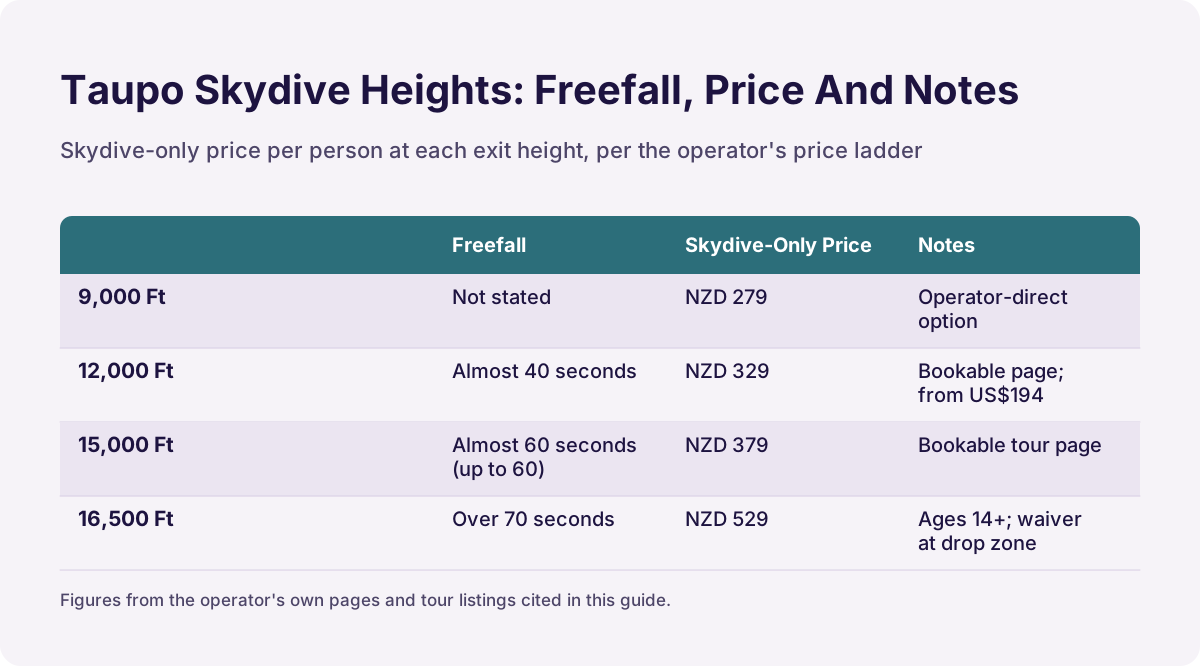
Freefall grows with altitude, roughly 20 extra seconds for each big step up the ladder. The operator states almost 40 seconds at 12,000 ft, almost 60 seconds at 15,000 ft and over 70 seconds at 16,500 ft. No freefall figure is stated for 9,000 ft, and the operator publishes no speed in km/h or mph, so any speed number you have seen elsewhere is not an operator figure.
Those seconds are the core of what you are buying when you pick a height. Going from 12,000 to 15,000 ft adds roughly a third more freefall; going all the way to 16,500 ft nearly doubles the 12,000 ft figure. The differences matter most to people who have already jumped once and want the longest fall they can get, and matter least to a nervous first-timer who mainly wants the experience over the lake.
| Exit height | Freefall, operator-stated | Skydive-only price (NZD) | Notes |
|---|---|---|---|
| 9,000 ft | Not stated | NZD 279 | Operator-direct option; no tour page of its own |
| 12,000 ft | Almost 40 seconds | NZD 329 | Bookable as the 12,000ft Tandem Skydive; from US$194 on its tour page |
| 15,000 ft | Almost 60 seconds (up to 60) | NZD 379 | Bookable as the 15,000ft Tandem Skydive |
| 16,500 ft | Over 70 seconds | NZD 529 | Ages 14+; high-altitude waiver; operator-direct option |
No canopy-time minutes are stated for any height, and none are invented here. The operator's duration guidance is operation-wide, not per altitude: the skydive portion takes about 30 minutes and the whole visit finishes in about 2 hours, with the FAQ suggesting you allow 2 to 3 hours and the terms suggesting 3 hours. If timing shapes your day, the full breakdown of how long a Taupo skydive takes covers it in detail.
How Much Does Each Altitude Cost?
The jump alone costs NZD 279 at 9,000 ft, NZD 329 at 12,000 ft, NZD 379 at 15,000 ft and NZD 529 at 16,500 ft, per person, on the operator's own price ladder. The 12,000ft Tandem Skydive tour page separately shows from US$194, the only US dollar figure printed anywhere on this site, and it is not a conversion of the NZD price. Camera packages bundle the jump and the media into one total.
The package prices below bundle the jump with a camera option, using the operator's own tiers: Ace is selfie HD photos, Pro adds selfie HD video, Guru uses a separate freefall camera flyer, and Legend at 15,000 ft combines freefall and selfie video and photos with an exit photo. Details of each tier are on the operator's photo and video page, which also quotes standalone cameras "from NZD 25 up to NZD 300" with 10 percent off a camera package booked online.
| Height | Jump only | Ace package | Pro package | Guru package | Legend package |
|---|---|---|---|---|---|
| 9,000 ft | NZD 279 | NZD 438 | NZD 478 | Not offered | Not offered |
| 12,000 ft | NZD 329 | NZD 488 | NZD 528 | NZD 608 | Not offered |
| 15,000 ft | NZD 379 | NZD 538 | NZD 569 | NZD 658 | NZD 759 |
| 16,500 ft | NZD 529 | NZD 688 | NZD 719 | Not offered | Not offered |
Two surcharges sit outside the ladder: a 15 percent surcharge on the skydive (not on photos or video) on New Zealand public holidays, and a 1.5 percent credit-card surcharge. Every jump includes a certificate of completion and a free neck buff, with 50 percent off a T-shirt on 15,000 ft and higher packages. For ways to trim the cost, see deals and vouchers for a Taupo skydive.
The pricing gap between the bookable tours is worth a close look. The 15,000 ft rung sits NZD 50 above the 12,000 ft rung on the operator's ladder, and roughly 20 freefall seconds sit between them. Whether that trade is worth it depends on whether this is a once-only jump or the first of several, a question the 12,000 versus 15,000 ft comparison handles directly.
“They have to do it. Nathan was awesome he made you feel comfortable would I do it again hell yes thank you for the experience”
Reading the table as add-ons makes the camera tiers easier to compare. Ace adds NZD 159 to the jump at every height, Guru adds NZD 279 at both 12,000 and 15,000 ft, and Pro adds NZD 199 at 9,000 and 12,000 ft but NZD 190 at 15,000 and 16,500 ft. Legend, at NZD 380 above the 15,000 ft jump, is the only add-on that tops the operator's standalone camera ceiling of NZD 300; every other upgrade lands inside the quoted NZD 25 to 300 band.
The two surcharges are small but easy to price in advance. The 1.5 percent card fee works out to about NZD 4.19 on the 9,000 ft jump and about NZD 7.94 at 16,500 ft. On a New Zealand public holiday, the 15 percent skydive surcharge adds NZD 41.85 at 9,000 ft, NZD 49.35 at 12,000 ft, NZD 56.85 at 15,000 ft and NZD 79.35 at 16,500 ft.
Availability narrows as the tiers climb: the Guru package runs only at 12,000 and 15,000 ft, and Legend only at 15,000 ft, so the two camera-flyer options cover the fewest heights on the ladder.
Which Rules Change With Height: Age, Waivers And Cameras?
Three rules move with altitude. The general minimum age is 8, but 16,500 ft is restricted to ages 14 and over and needs a high-altitude waiver signed at the drop zone. An outside freefall camera, a separate flyer falling alongside you, is not offered at 9,000 or 16,500 ft, though a handycam package is. Everything else, weight assessment, ID and medical questions, is the same at every height.
The age ladder, as the operator states it in its FAQ: minimum age 8, no upper age limit, with the oldest jumper the operator mentions being 95. Anyone under 18 needs written parental or guardian consent. Children under 14 are individually assessed and must be accompanied in the plane by an adult they know who pays for a skydive. Government photo ID is required, and 16,500 ft adds the 14-plus floor and the waiver.
Weight is height-blind: the operator assesses anyone up to and over 100 kg individually through its Safety Officer, states no fixed maximum and no surcharge, and asks people over 100 kg to phone the office on 0800 826 336. The one hard weight figure in Taupo belongs to the helicopter combo only, whose booking page says it is not suitable over 136 kg (300 lb); that limit never applies to the skydive-only jumps. The weight limit guide untangles this properly.
Medical rules are the same at every height: see a doctor first if you have any doubt, the operator may decline a jump for safety, no scuba diving within 24 hours, and no drugs or alcohol. No condition-by-condition list is published, so specific questions go to the operator rather than to guesswork.
Planning around these rules is mostly a matter of sequencing paperwork. Because the 16,500 ft waiver is signed at the drop zone, it cannot be sorted out in advance, so allow a few extra minutes at check-in for a 14-to-17-year-old jumping that height, where the age floor, the guardian consent and the waiver can all land on the same person at the same desk. Consent for under-18s is written, so if a parent or guardian is not travelling to Taupo, the signed form still has to make the trip. The under-14 rule carries a cost implication worth spelling out: the accompanying adult must be someone the child knows and must pay for a skydive, so a booking for a young jumper is effectively a booking for two jumpers. The adult is in the plane because they are jumping, not spectating, which removes any thought of a non-jumping seat for a nervous parent.
The camera split should shape the height decision before any price comparison does. An outside freefall camera puts a second flyer in the air with you, and that setup is simply not part of the 9,000 or 16,500 ft products; at those heights the handycam package is the way to leave with footage. The handycam does not depend on a second person in the air, which is why it stays on the menu where the outside camera drops off. Anyone set on outside shots therefore has one altitude that delivers them: the height in between. Run the same logic from the age side and choices narrow further for younger families. A 13-year-old cannot book 16,500 ft under the 14-plus floor, so where outside footage also matters, the mid-range altitude is the only height that satisfies both the age rule and the camera preference. The arithmetic is simple, but doing it before booking prevents arriving at the drop zone with a plan the rules do not allow.
“I had an amazing skydiving experience with you today, June 19, 2025! The 12,000-ft jump, professional guides, and seamless hotel pick-up and drop-off were outstanding. Thank you for an unforgettable adventure!”
On the weight side, the practical order of operations is call first, book second. The over-100 kg phone call is how the individual assessment starts, and because the operator states no fixed maximum, no surcharge and a case-by-case process through its Safety Officer, the outcome of that conversation, not a published number, decides what happens next. An approved jumper over 100 kg pays the same as anyone else at the chosen height. The 136 kg figure behaves differently: it is a suitability limit on the helicopter combo only, so someone above it still has a route into the skydive-only jumps through the same assessment, while the combo is simply the wrong product for them. On medical questions, the absence of a published condition list makes early disclosure the efficient move, and settling any doubt with a doctor belongs before the booking rather than the boarding. The 24-hour scuba rule is the one that bites travellers who stack activities, so if a dive sits on the itinerary, the jump needs a later day. Since the operator can decline a jump for safety at any altitude, the three rules that move with height are best read as the exceptions, not the pattern.
What Does The Highest Taupo Jump Actually Mean?
The operator's 16,500 ft jump is its highest, and the operator describes the exit as "nearly 18,000 ft above sea level". That is not a fifth height or a different jump: the drop zone at Taupo Airport sits well above sea level, so the same exit reads two ways depending on the reference point. 16,500 ft is the number the operator uses for pricing, and it is the highest number it sells.
Two traps live around this figure. The first is the "18,500 ft" claim that circulates on some summary pages; the operator offers no such jump, and its own prices page tops out at 16,500 ft, NZD 529. The second is the freefall pairing: over 70 seconds, the longest stated fall of the four, but with the outside freefall camera unavailable, so the biggest jump and the most dramatic camera angle cannot be combined. A handycam package is the alternative at that height.
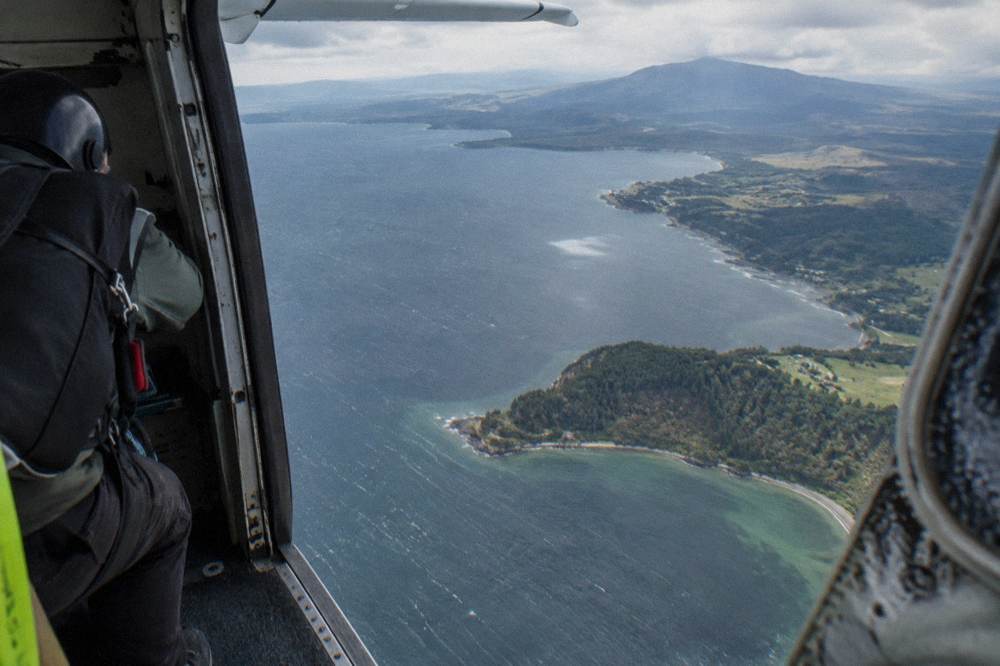
Booking 16,500 ft runs through the operator rather than through a dedicated tour page. One exception is worth knowing: the helicopter combo's official page says you can upgrade to 16,500 ft at the drop zone, which is the one stated path to the top jump that starts from a bookable product. Ask the operator on 0800 826 336 about availability for a direct 16,500 ft booking.
Which Height Should You Actually Book?
For a first jump, the 12,000 ft rung is the established choice, with a 5.0 rating across 457 reviews, from US$194 and free cancellation up to 24 hours before. For the longest fall on a bookable page, take the 15,000ft Tandem Skydive, at almost 60 seconds of freefall. Book 16,500 ft directly with the operator if you want the stated maximum of over 70 seconds and accept its camera and age limits.
The honest framing is that the freefall difference between 12,000 and 15,000 ft, roughly 20 seconds, is real but not transformative on a first jump, and plenty of first-timers choose the lower rung and put the saving toward a camera package instead. That is the logic the first-time skydiving in Taupo guide walks through in full.
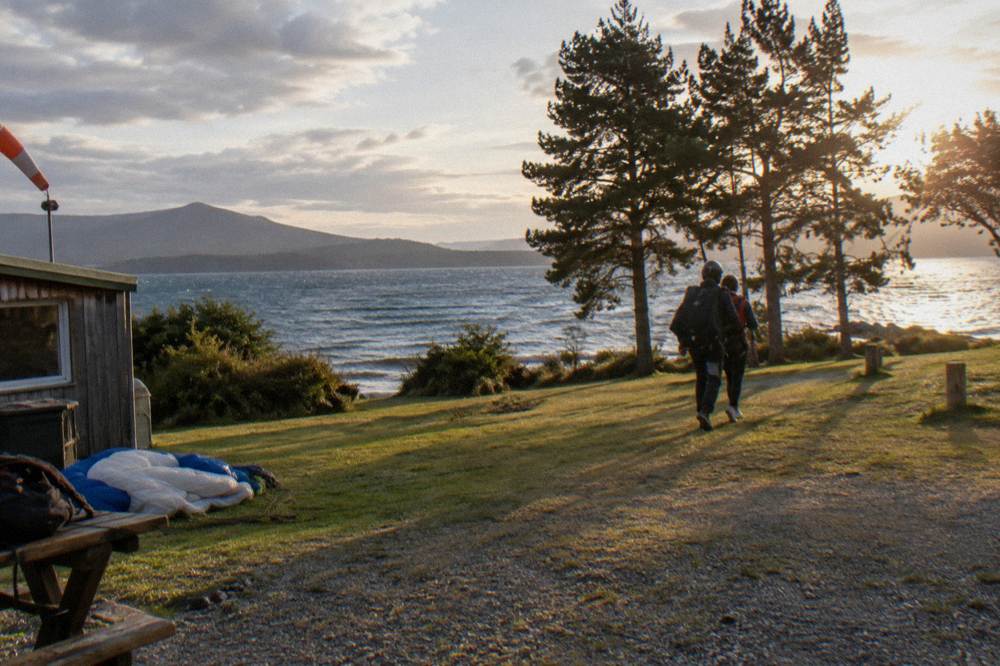
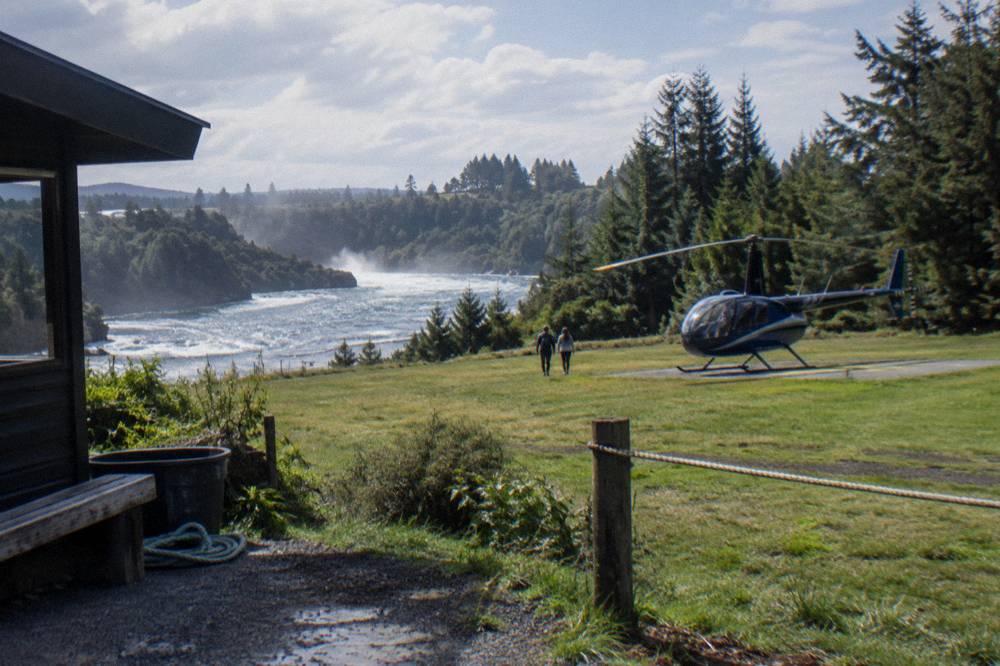
A third path suits people for whom the flight up matters as much as the fall. The Helicopter Flight, 15,000ft Skydive pairs a 12-minute helicopter flight over the Huka Falls area with a 15,000 ft jump and up to 60 seconds of freefall, from NZ$599 per person with a minimum of two passengers, photos and videos included per the booking page, and free cancellation up to 24 hours before. It is new and carries no rating yet. It starts from the Huka Falls Road area rather than the airport drop zone, which makes it the only option here that does not begin at Taupo Airport.
What Trips People Up When Choosing A Skydive Height?
The most common mistakes are assuming all four heights are bookable tour pages, expecting a canopy-time figure that no one publishes, and reading the "nearly 18,000 ft" line as a bigger jump than the one on sale. Others book 16,500 ft expecting the freefall camera, which that height does not offer, or quote a fall speed the operator has never stated. Checking the operator's own pages against each claim solves all five.
Concretely, the traps look like this. Only 12,000 and 15,000 ft have tour pages; 9,000 and 16,500 ft are operator-direct, so a search that only surfaces two options is not showing the whole ladder. No canopy minutes are published for any height, and no per-altitude duration exists either: the about-2-hours figure is operation-wide. The 18,500 ft figure seen on some summary pages is not offered. And the 40 seconds at 12,000 ft is "almost 40", not a round 40, which matters if you are comparing second-for-second.
People also misread who is jumping with them. Every option here is a tandem jump with a tandem master, from the same drop zone, whether the booking starts on a tour page, at Taupo Tandem Skydive itself, or over the phone. If a detail is not stated, the operator's line is 0800 826 336, and the operator's FAQ answers most height questions directly.
Common Questions About Taupo Skydive Heights
How High Is A Taupo Skydive?
Taupo tandem jumps are offered at four exit heights: 9,000, 12,000, 15,000 and 16,500 ft above the drop zone at Taupo Airport. The operator calls 16,500 ft its highest jump and describes it as "nearly 18,000 ft above sea level".
How Long Is The Freefall At Each Height?
The operator states almost 40 seconds at 12,000 ft, almost 60 seconds (up to 60) at 15,000 ft and over 70 seconds at 16,500 ft. No freefall figure is stated for 9,000 ft, and no speed in km/h or mph is published for any height.
Is 16,500 Ft The Highest Skydive In Taupo?
Yes. The operator lists 16,500 ft as its highest jump at NZD 529 for the skydive alone. It is restricted to ages 14 and over, requires a high-altitude waiver at the drop zone, and does not offer the outside freefall camera. No 18,500 ft jump exists.
Does A Higher Jump Take Longer On The Day?
Not in any way the operator states. The duration guidance is operation-wide: the skydive portion takes about 30 minutes and the visit finishes in about 2 hours, with the FAQ suggesting 2 to 3 hours. No per-altitude duration is published.
Which Heights Can I Book On A Tour Page?
Two: the 12,000ft Tandem Skydive, rated 5.0 across 457 reviews and showing from US$194, and the 15,000ft Tandem Skydive, which has no printed rating or price. The helicopter combo adds a 15,000 ft jump after a 12-minute flight. The 9,000 and 16,500 ft options are booked through the operator.
Does The Minimum Age Change With Height?
Once. The general minimum age is 8, with written parental consent under 18 and individual assessment under 14. The 16,500 ft jump alone is restricted to ages 14 and over.